
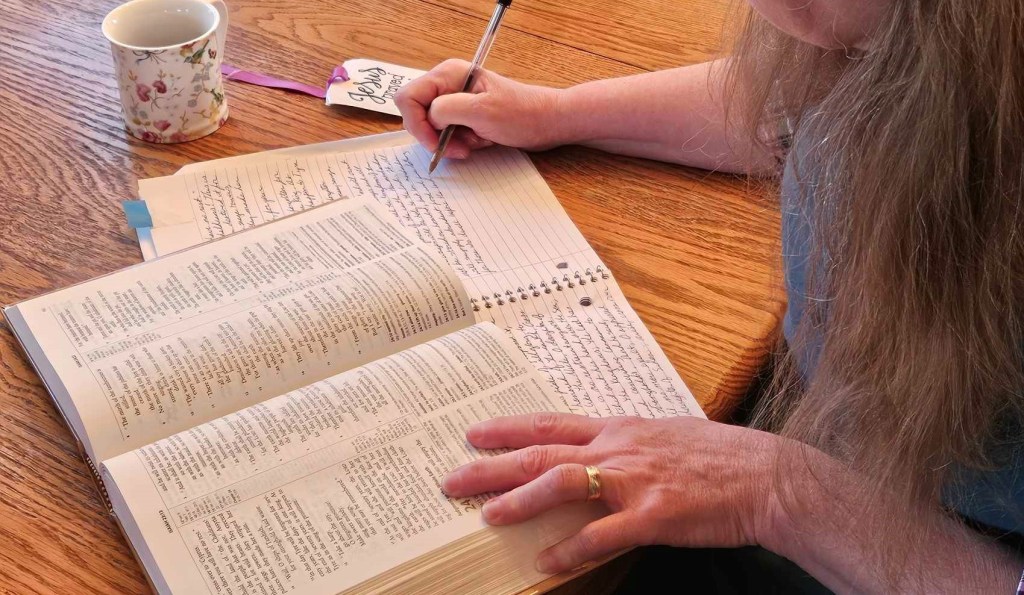
Six years this month. That’s how long I’ve been doing daily Scripture writing: copying out the Word of God by hand, passage by passage, book by book.
I began slowly, with just a few verses a day, following an easy, three-year plan that was organized by theme. When I finished that, I wanted more, so I started copying out entire books of the Bible—and I’m still at it. You can read how all of this developed (not only for me but for two of my friends) in Ready to Try Scripture Writing?, which is still the most-read post on this blog.
Even after six years of daily copying, one thing remains the same for me: Scripture writing has transformed my time with God’s Word more than anything else I’ve ever done.
There are scientific reasons that would explain this. Research has shown that writing things out by hand is more beneficial than we might have thought. It helps your memory more than typing (articles here, here, here, and here, among many others), and writing by hand has also been shown to help you learn and retain knowledge (discussed here, here, and here).
But the reason why I continue to write out Scripture isn’t because I’m following the science. Instead, I’m copying Scripture because:
- Scripture writing is the one thing that has made me read my Bible every single day without fail—and without ever feeling stressed, rushed, whiny, apathetic, or merely dutiful about it.
- I understand and retain what I read more than I have with other daily Bible reading, and I feel a more personal connection to God’s intention for each book after I’ve finished writing it out.
- My time with the Bible is something I honestly look forward to every morning.
- Writing out Scripture has challenged and inspired me in new ways, and is helping me grow as a Christian.
- It’s simply fun! I love using my notebooks, my Scripture writing tracker, my colored pens, my study Bible, and my companion study guide that helps keep me focused.
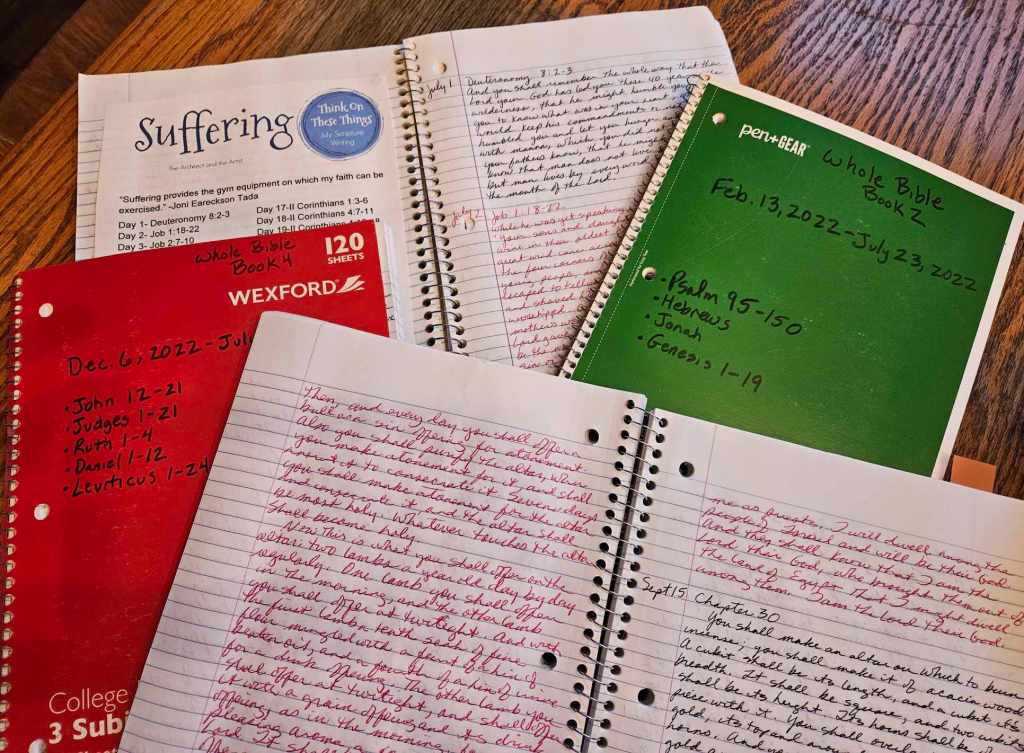
I know it may seem daunting, but writing out whole books of the Bible isn’t nearly as hard as it sounds. My plan is to copy the entire Bible, and my best estimate for how long this task will take is seven to ten years (I just started year four of writing out whole books). I suppose that could sound discouraging, but I feel just the opposite: my enthusiasm for Scripture writing hasn’t lessened, my enjoyment hasn’t diminished, and my only thought is, what will I do after those seven or ten years are up and I’ve written the whole thing?
Maybe, like me, you’ve been writing out Scripture for years. Maybe you’re dabbling here and there and wondering if you should continue. Maybe you’re thinking about giving it a try. No matter where you are on the Scripture writing spectrum, here are five tips to encourage and inspire you to make the most of your journey.
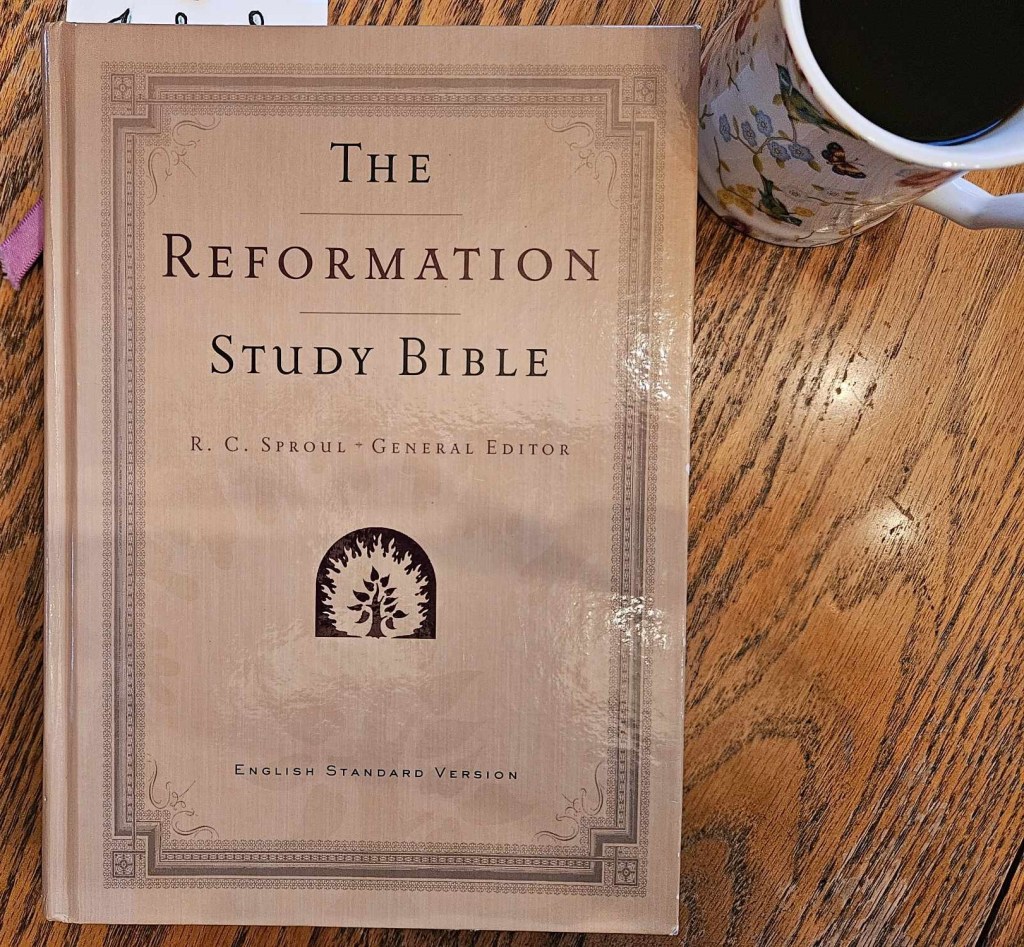
- Choose a good study Bible to copy from and go slowly enough to read many or most of the notes. I use the Reformation Study Bible, but there are many excellent study Bibles you can choose from (this one, for example), in a translation that you’re most comfortable with. You want reliable, concise notes that will help you understand what you’re writing out. One of the biggest advantages to Scripture writing over, say, reading the whole Bible according to a certain plan (which I still recommend doing), is that you are in charge of how much you write each day. This means that you can spend more time reading your Bible’s study notes or articles if you so choose.
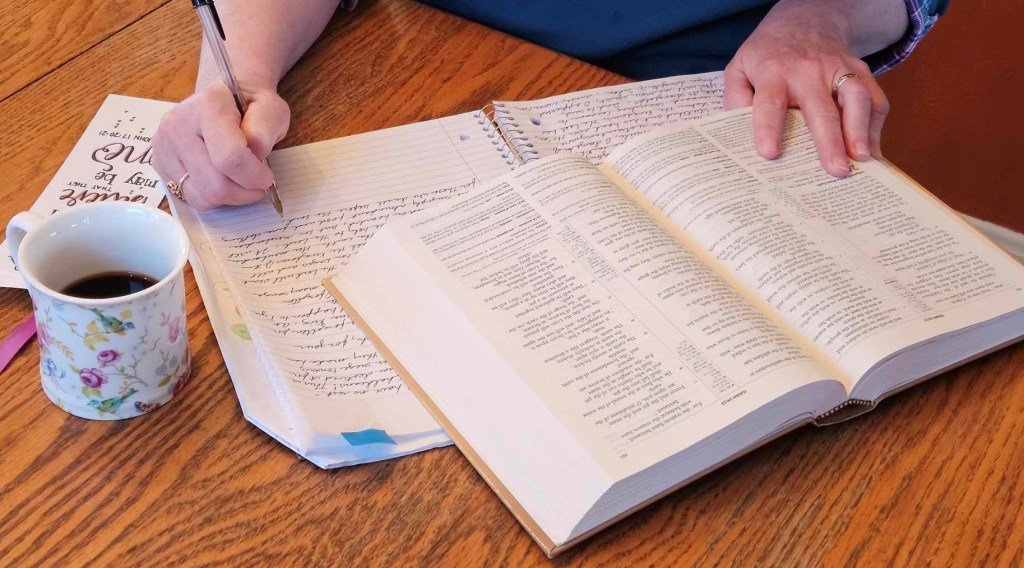
- Aim for the same time each day to copy Scripture. I know this isn’t always possible, but it’s so helpful for forming the habit. For me, Scripture writing happens every morning right after feeding the pets. There have been other seasons in my life when I could have copied Scripture after the kids were in bed, during their naps or quiet time, or even during homeschooling—because remember, you determine how long you write, and sometimes that might mean only five or ten minutes, if that’s all you’ve got. My personal maximum time for writing is fifteen or twenty minutes, tops.
- Use paper and pens that you enjoy. For me, this means I use regular spiral notebooks and colorful pens. I’m not picky about my notebooks, so I just purchase whatever is cheap during the back-to-school sales in August. You’ll need to decide between wide rule or college rule (I’ve used both), and don’t go higher than 120 sheets because lots of writing will warp the pages a bit and it becomes harder to write on. My favorite pens range from random dollar store colored pens to Bic Xtra Bold 1.6 mm pens (very thick and bright) to my new favorite, the Pilot Precise rollerball pens (assorted colors in fine 0.7 or extra fine 0.5 thickness). Paper Mate InkJoy is another good alternative, available in ballpoint and gel. I have a list of colors posted on my pen container that ensures I use all the colors in the same order—which tells you something about me, I’m sure.
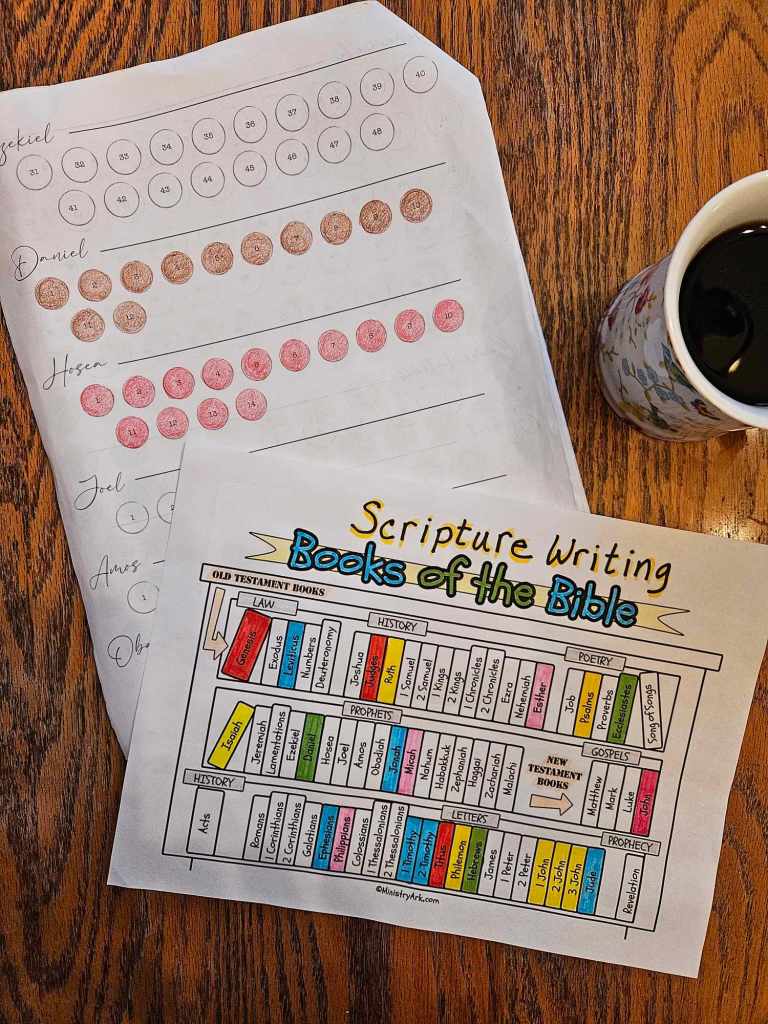
- Keep track of your progress in a way that inspires you. When I finish each chapter of the Bible, I fill in a circle on my Scripture Writing Tracker (you can download a free copy from this post). When I finish an entire book, I highlight it on my Books of the Bible “bookshelf.” Both of these small activities show my progress and help keep me motivated to press on.
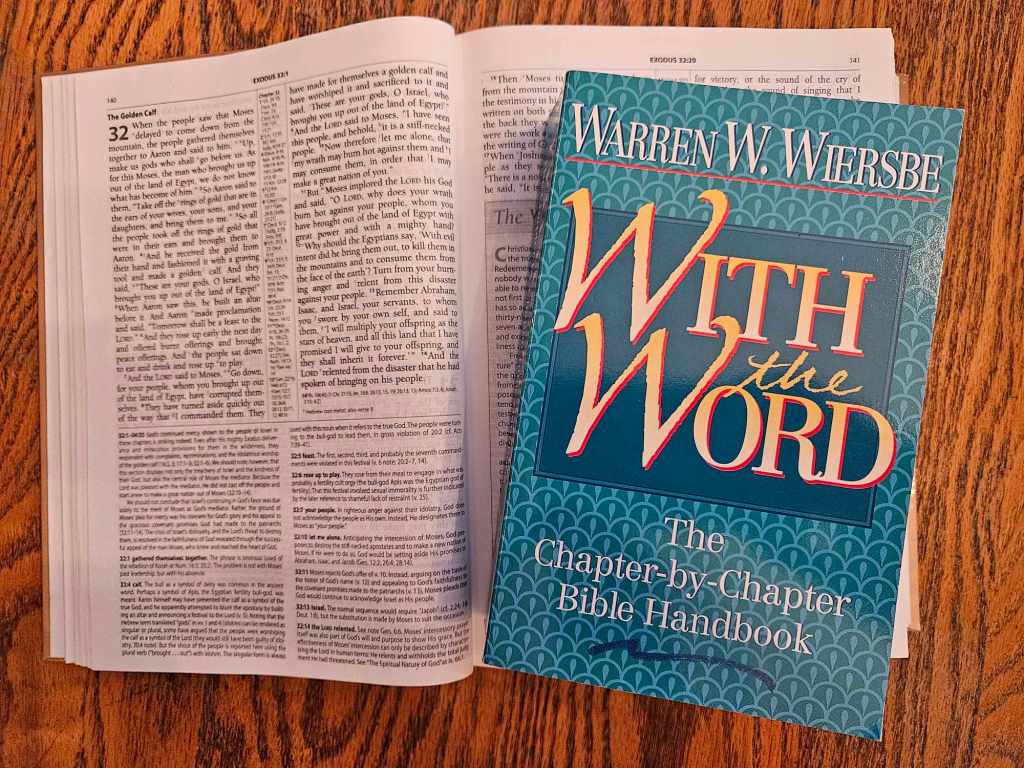
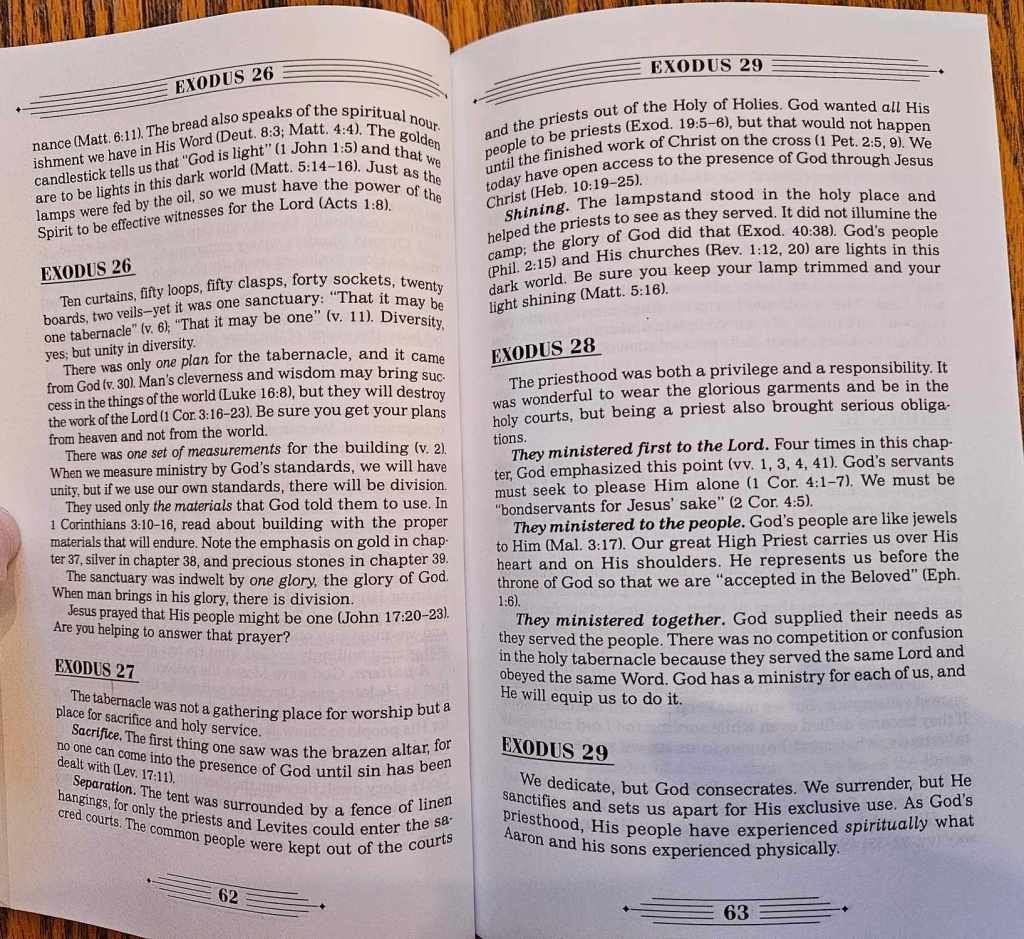
- Consider adding a chapter-by-chapter Bible handbook to help you stay focused. This is especially helpful when copying some of the longer or more challenging books. I absolutely love Warren Wiersbe’s With the Word handbook, which gives a short, meaningful summary of every chapter in the Bible. I first used it when I was copying Isaiah, and I was having trouble staying focused. Isaiah is a really long book, and it’s somewhat repetitive (you realize this when you’re literally writing out every word of it, trust me). But when I read With the Word every two or three days at the beginning of each chapter, it focused my attention on what was being said, and why. It was very much worth the extra couple of minutes before I began writing out the passage. Just recently, I found this handbook equally helpful in Exodus, when God spends seven chapters giving many detailed instructions for how to build the tabernacle and make the priests’ garments. Thanks to With the Word, I’m not only better able to focus on why all of these instructions are important and interesting, but I’m learning (or being reminded) of why these outwardly tedious chapters are actually relevant to my own life and to my relationship with the Lord. Second Timothy 3:16 tells us that “All Scripture is breathed out by God and profitable for teaching, for reproof, for correction, and for training in righteousness”—and that includes even the driest and most boring parts of Exodus.
Three years ago, when I first thought about maybe, possibly writing out entire books of the Bible, one of my first questions was, how would I choose which book to write? Maybe you wonder the same thing. So here’s a list, in order, of the 25 Bible books that I’ve already written out, and the reasons why I chose them. Notice the “careful randomness” of the choices:
- Philippians – because I was about to teach it, and also, what a profound and joyful book!
- Psalms – because the Psalms are beautiful, and I wanted to see if I could really handle copying 150 chapters
- Hebrews – because I was considering teaching it (I didn’t) and then my pastor preached a sermon series on it
- Jonah – because it was short, and I wanted to get started on the prophets
- Genesis – because it’s full of great stories, and I hadn’t written out a narrative yet
- John – because I wanted one of the Gospels, and John is my favorite
- Judges – because I was about to teach it, and because I didn’t like it
- Ruth – because it goes with Judges, and also, I love it
- Daniel – because he’s my favorite prophet (although the second half of Daniel is a bit weird)
- Leviticus – because I was about to attend a summer Bible study on it
- Esther – because it’s a great story, and also my daughter was writing it out at the time
- Titus and Philemon – I can’t remember … because they were short?
- Ecclesiastes – because I was wanting another book of wisdom literature
- Micah – because he’s another prophet and I have to get through all of them
- Ephesians – because I was choosing between Galatians and Ephesians and Ephesians somehow won
- Hosea – because I had finally read Redeeming Love and I wanted to write out the real story
- 1, 2, 3 John – because I was about to teach them
- Isaiah – because I felt up to the task of tackling the longest prophet
- Jude – because I wanted a short book, and I couldn’t remember much about Jude
- 1 & 2 Timothy – because I hadn’t read them in a long time
- Exodus – because I wanted another long Old Testament narrative
Of course, your choices will probably be different than mine! My goals are to stay motivated, not get bored, and above all, not get stuck with too much of one thing at the end of my task—like all of the history books or all of the prophets. (I’ve decided to end my copying out the entire Bible with Revelation, though, because what could be a better way of ending seven to ten years of Scripture writing than the final two chapters of Revelation?)
At my current rate of writing and if the Lord allows, I estimate that I have four to seven more years of daily Scripture writing ahead of me before I’ve copied the whole Bible. These numbers aren’t daunting to me at all—in fact, just the opposite. I hope the years don’t go too quickly, because continuing this habit is like waking up every day knowing there’s a dear friend waiting for me in the next room. I’ll miss it when I’ve reached the end … so the chances are good that I just might start all over again.
Podcasts:
I had a great talk with Kate of Kurt and Kate Mornings (Moody Radio Florida) about Scripture writing and this post. Take a listen here! (16 min.)
John at WORD FM Pittsburgh had questions for me and I enjoyed giving many practical answers and a few insights into what I love about Scripture writing. Listen here, starting at 24:10. (15 min.)
.
Read more: I talked with my friend Andy at Bible Copy Club a while back about Scripture writing, and he wrote about our conversation in this post. Bible Copy Club delivers short passages to copy and accompanying meditations to your email, putting each passage into context.
The links for qualifying purchases in this post earn me a small commission from Amazon, which I use to offset the costs of running this site.

 Great and Noble Tasks
Thank you so much for writing this! How interesting and inspiring! I had never heard of doing this as a practice and will give it a go.
LikeLike
You’re welcome, and I hope you enjoy giving it a try! It’s so flexible and you are in charge of what you write and how much – so I think it’s doable for just about anyone who would enjoy writing by hand and interacting with God’s Word in a new way.
LikeLike
Love your thoughts about writing out Scripture. I have been journaling for a while. I write out portions (passages or small chapters) of the Bible I have memorized and later proctor it myself. Have been memorizing Romans 8 recently and plan to write it out from memory soon.
It’s very rewarding as you point out!
God bless!!
LikeLike
Yes – thanks for mentioning Scripture memorization! I see how it could go hand-in-hand with Scripture writing. Writing it out from memory is a great idea if you’ve memorized Bible chapters or passages.
LikeLike
Hi, I love that I found this. I’ve been doing scripture writing for just a bit now. And it’s all over the place, all about certain subjects. So how did you know where to start?
thanks
Mandy y
LikeLike
So glad you’ve discovered Scripture writing! You can do it topically, with your own or someone else’s list (it’s easier to use someone else’s) – see the link to Debbie’s 3-year topical plan in my first post, called “Ready to Try Scripture Writing?” Or, if you want to just start writing out books of the Bible, you can do that, too. I give more details on that in this post. I’d also recommend listening to the podcast I linked just above, when I was a guest with Kurt and Kate Mornings. She asked me a few questions about why and how I began, and I talked about both of those methods with her. That podcast link is right under the last picture in this post.
LikeLike
Rebekah, because of one of your older posts I started Scripture writing last year. I’ve been copying the book of Proverbs. Progress has been slow because of the birth of a new baby, but even with that I’ve seen God working on me. Plus I have truly enjoyed the time writing out the verses.
LikeLike
That’s wonderful! Thanks for letting me know. I love the flexibility of Scripture writing – you can write just as much or as long as you’re able each day (or in each season of life).
LikeLike