
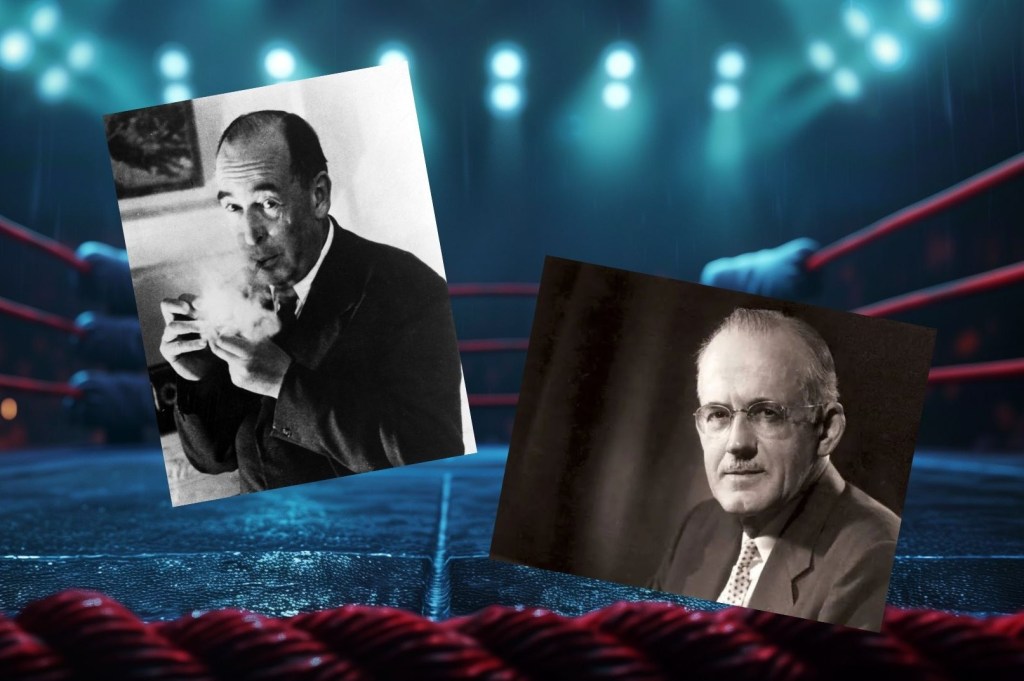
Was it purely coincidence that out of thousands of books in the bookstore that day, I bought these two books? You be the judge.
Because my children know me well, I got a gift card to Barnes & Noble for Mother’s Day, so I went in person to take a look around. (Real bookstores are analog paradise, and I thank God that they still exist!)
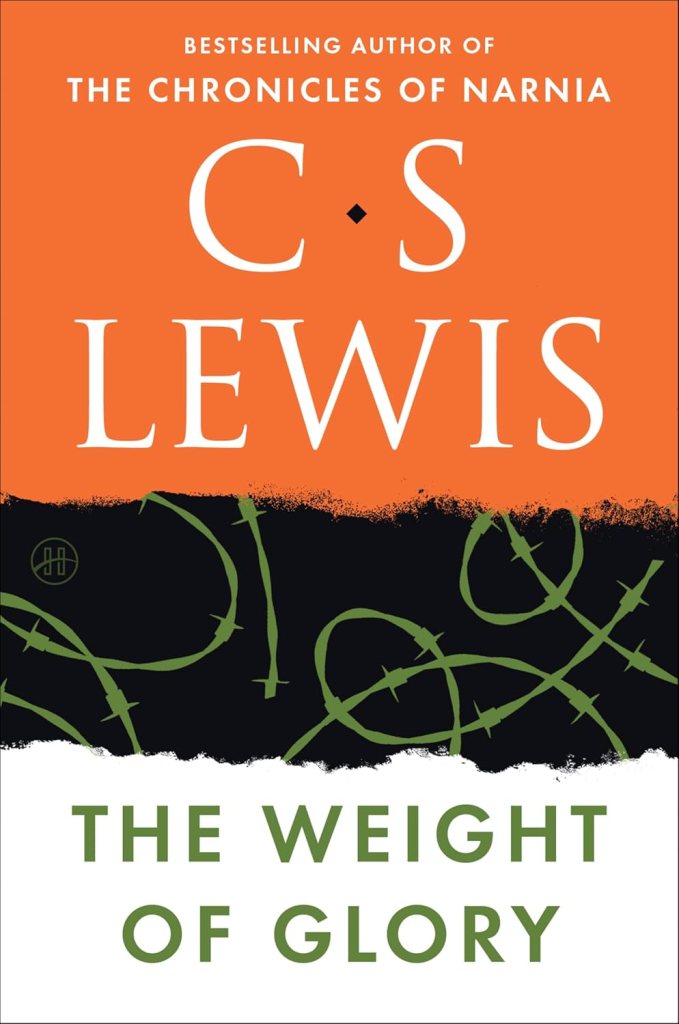
With the gift card burning a hole in my pocket, I headed first to the Religion/Christianity section and was pleased to see that it was well stocked. Three or four large bookcases, front and back, were packed with Bibles and other Christian writings. I instinctively gravitated toward C. S. Lewis, like meeting up with an old friend, looking specifically for On Writing (and Writers): A Miscellany of Advice and Opinions. Sadly, they didn’t have this book, but they did have one Lewis title that I’d been wanting for a while: The Weight of Glory. Without even looking at the contents, I grabbed it and kept browsing.
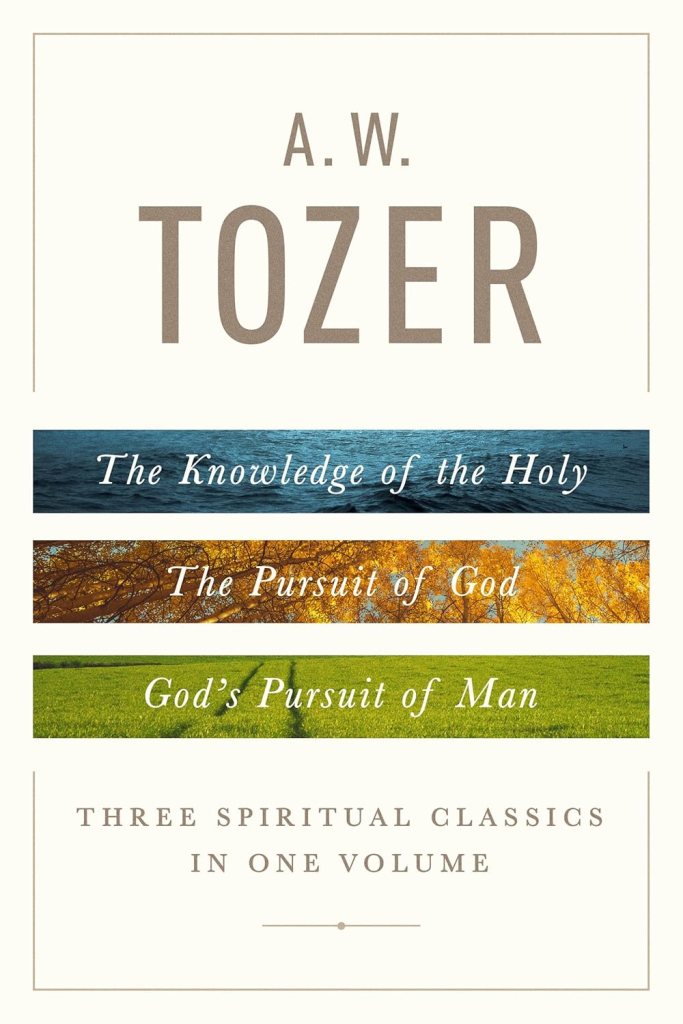
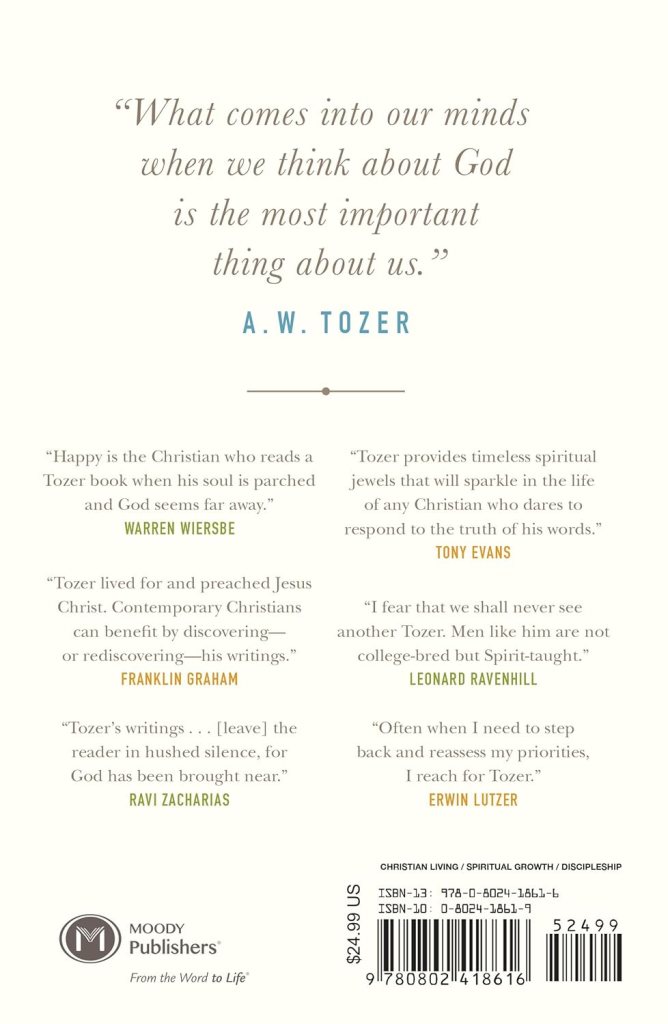
The next bookcase to the right had several titles displayed face-out, and one caught my eye: A. W. Tozer: The Knowledge of the Holy, The Pursuit of God, and God’s Pursuit of Man: Three Spiritual Classics in One Volume. It was a small, thick, hardcover book in perfect condition, with a beautiful cover. Hmmm, A. W. Tozer. I knew the name because I’d seen his quotes many times on social media, church bulletins, and various other places over the years. I knew he was trustworthy, and when I read the jacket copy and the back of the book, I was sold. This lovely 3-in-1 book was going home with me that very day.
(I also bought myself a puzzle, a toy for a friend’s baby, a really expensive chocolate bar because I don’t often run across Bissinger’s dark chocolate blood orange caramel bars, and two Agatha Christies. I did indeed go over my gift card limit, and was happy to do so.)
Maybe you’ve read The Weight of Glory. Even if you haven’t, you’ve probably seen parts of it because it’s one of Lewis’s most quoted books. But this book may not be what you’d think it is. It’s actually a selection of shorter pieces mostly from the 1940s that Lewis delivered as sermons or talks—much as he had delivered the wartime radio talks that eventually became Mere Christianity. “The Weight of Glory” itself is the first essay in the book, just 21 pages long. There are eight more essays, plus a lengthy Introduction by Walter Hooper that offers a poignant, highly personal look at the last months of Lewis’s life. Now, the other essays in the book are good … but “The Weight of Glory” is tremendously good, and along with the unique Introduction, is worth the whole price of the book. Hooper, in his Introduction, calls this sermon, preached by Lewis in 1941 at Solemn Evensong in the 12th-century Oxford University Church of St. Mary the Virgin, “magnificent,” and he considers it “worthy of a place with some of the Church Fathers.” I agree.
If you’ve ever longed for heaven, if you’ve ever felt an indescribable desire for something else, something you can’t put your finger on but you know you are meant for, then “The Weight of Glory” essay is one that you simply must read. I savored every word of this piece on the very evening of my bookstore visit.
And then, right in the middle of it, I came upon this quote:
“I read in a periodical the other day that the fundamental thing is how we think of God. By God Himself, it is not! How God thinks of us is not only more important, but infinitely more important. Indeed, how we think of Him is of no importance except insofar as it is related to how He thinks of us.”
I stopped short. Here was Lewis in vehement disagreement with an unnamed writer. I read it twice more and racked my brain. Where had I seen this before?
Then I remembered. I reached a mere twelve inches to my right and took my brand-new A. W. Tozer book from the end table. Right there on the back cover, in a large italic font, was this Tozer quote:
“What comes into our minds when we think about God is the most important thing about us.”
That’s the very first sentence of The Knowledge of the Holy.
I sat in disbelief for a moment. What were the odds that I had bought the exact two books, out of all the books available in that huge bookstore, that had this kind of uncanny connection? And that the Tozer quote would be so prominently featured on the cover of his book that I would remember it even as I read Lewis’s essay?
My first thought was that this was clearly God’s doing. My second thought was a sudden desire to know if there had been any further drama between these two giants of Christian thought. If there was, I wanted to know about it.
I immediately googled “Lewis vs. Tozer.” Sure enough, Lewis’s strongly worded comment in “The Weight of Glory” was a rebuttal against Tozer’s opening line to The Knowledge of the Holy.
I wondered … did they ever discuss or debate this? I dug a little deeper: Tozer was a self-taught American theologian and pastor who lived from 1897–1963, while Lewis was a British author, scholar, and lay theologian who lived from 1898–1963. So they were contemporaries (strikingly so—look at those dates), aware of and readers of each other’s works, at least to some extent, but apparently they never met or corresponded. There was no drama after all, which was actually a relief to me.
Both men are highly esteemed, often quoted, and widely read yet today. So on this topic of “what’s more important: what we think of God, or what he thinks of us?”, who is right?
On that question, no googling is necessary. Just as we can understand the contradictory idea of “the already and the not yet” in our personal theology, we’ve also been given the blessing of “both/and.” Both/and simply means that two things can be true at the same time—for example, both God’s sovereignty and human responsibility are real and true. Two things that appear to be opposites or in conflict are sometimes both true, and this goes for apparent contradictions in the Bible, as well.
So there is actually no drama between Lewis and Tozer (move along now, reader, nothing to see here), but what a gift they’ve both given to us! “What God thinks of us” and what we’re truly made for is explored so beautifully in “The Weight of Glory” that I had to put it down several times just to catch my breath and compose myself enough to read on. And “What we think of God” is covered in such clear and intricate detail by Tozer in chapter after chapter on each of God’s attributes—such a perfect way to meditate on who God is and use in the adoration or praise part of your daily prayer.
So was it purely coincidence that out of thousands of books in the bookstore that day, I bought these two books? I think not. And I thank God for both of these men, their writings, and that they did not, after all, come to fisticuffs over this simple, yet profound question.
The links for qualifying purchases in this post earn me a small commission from Amazon, which I use to offset the costs of running this site.
Image courtesy of Pixabay and Canva; author photos from 1950s.


Thanks for this post. Tozer is one of my favorite preachers from his sermons on youtube, and I’ve read Pursuit of God at least twice. I think he’s fallen out of fashion in some Christian circles these days, which is too bad. His sermons are like no one else’s!
LikeLike
Thanks for your comment! I’m looking forward to reading more of his work, and I may check out those sermons.
LikeLike
We hardly ever, these days, ask about what “The Meaning of Life” is.
(Perhaps too many are too quick to quote mice in response… ’42’.)
But just because we don’t use the words much anymore does not mean we aren’t asking the question. We ask it every day — it’s just changed form. Now it looks like a blank that needs filling:
“The most important thing about me is ____”
We fill in the blank with all kinds of things… politics, religion, career, fashion, consumption, art.
Not necessarily bad things — but not quite enough, either. We know this because we keep erasing and starting over.
I’d propose that anything we place in that blank which comes from our own efforts will eventually fail us. We need to look to another to fill it — and not just any other.
“The most important thing about me is that I am loved by God.”
This echoes Lewis — the most important thing is not what I think of God, but what God thinks of me. And it echoes Tozer too, because the very act of looking to fill that blank orients us outward, toward God rather than ourselves. Both men turn out to be right, and pointing the same direction.
LikeLike
Great thoughts – thanks for your comment!
LikeLike
Dear Rebekah thank you so much for this very interesting and instructive comments. I was an eager reader of Mr Tozer in my early christian days (long time ago) and agree with you that there is a growing interest in C S Lewis works (and rightfully so), but it is with regret that not the same happens with Tozer’s. In relation to any conflict between these two wonderful thinkers I fully agree with your comments. Maybe we can even say these are two sides of a coin. On ther hand, Calvin starts his famous Institutes with the statement that to understand who we are we are supposed, or even must, begin knowing who God is. In my personal opinion one of the tragedies of our generation (and I mean not only unbelievers) is that we do not know enough about how God reveals Himself in his word and therefore end up by minimising the value of humans and our responsibilities and accontability before him. Once again thanks for this article. In Christ, Eurico
LikeLike
I think that’s why the (several!) Tozer books caught my eye at Barnes & Noble – I was pleasantly surprised to see them there. And yes, “two sides of a coin” for sure. Funny you should mention Calvin because my husband suggested including the sentence you mention at the end of this post. The reason I didn’t was because I think in our world today, the second part about knowledge of ourselves could be easily misinterpreted, and it might need its own post to explain it. (For anyone reading this, that sentence from Calvin is, “Nearly all the wisdom we possess, that is to say, true and sound wisdom, consists in two parts: The knowledge of God and of ourselves.”) Thank your for your thoughts!
LikeLike