
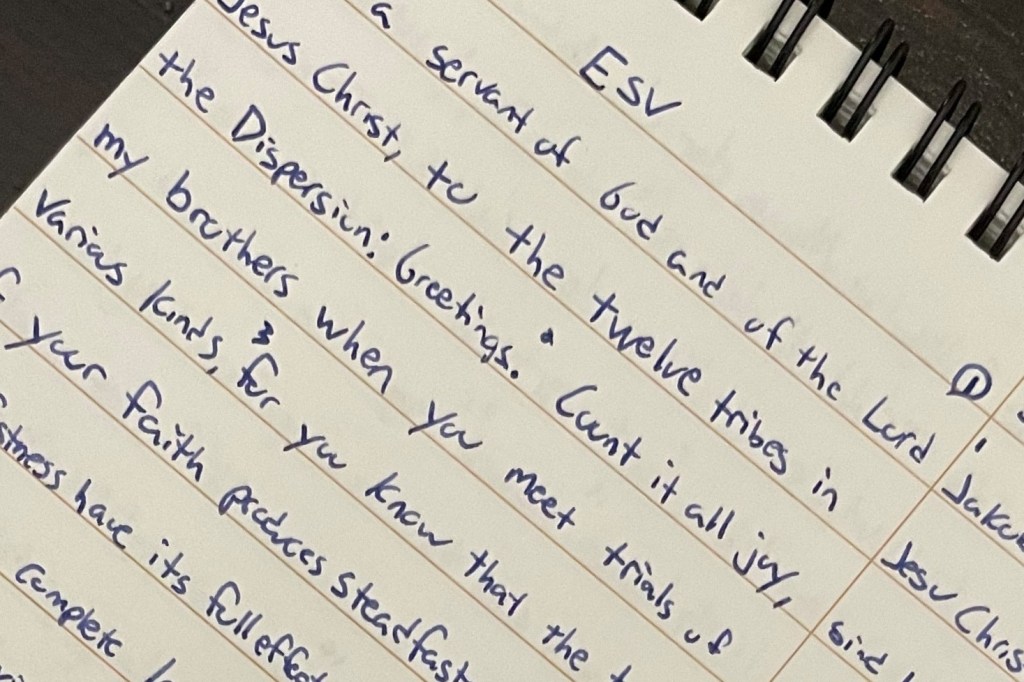
Over the years that I’ve been posting and teaching about Scripture writing, many of the same questions keep popping up. One of the most common questions is this: Do men do Scripture writing, too?
The answer is yes, they absolutely do! In fact, one of the biggest misconceptions about Scripture writing is that it’s something that only women do.
I’ve often wondered … why might people assume that Scripture writing is inherently a feminine thing to do? Especially since the scribes of centuries past were virtually all male, and it was a respected position in a temple or monastery (not to mention in the military, or in the court of a nobleman or king).
One of the reasons for this misconception could be that, here in the 21st century, “Scripture writing”—copying out the exact words of the Bible by hand—often gets confused with “Bible journaling.” Now, Bible journaling is a completely different practice, and is indeed most often practiced by women. Bibles designed for journaling are readily available (this one is a good example, or this one with artwork you can color) and usually feature wide margins, beautiful covers, and sometimes decorated pages. Readers (including men—here’s a more masculine journaling Bible) are encouraged to reflect on Bible passages and record their thoughts directly in the Bible. Many readers, especially women, go a step further and beautify their pages with washi tape, colored pens and pencils, calligraphy, drawings, artistic borders, etc.
(Just for the record: I am not a Bible journaler, illustrator, illuminator, decorator, or beautifier. I appreciate the artistry involved; it’s just not my personal interest or my gift. But Scripture writing? That I love, and I practice it every day.)
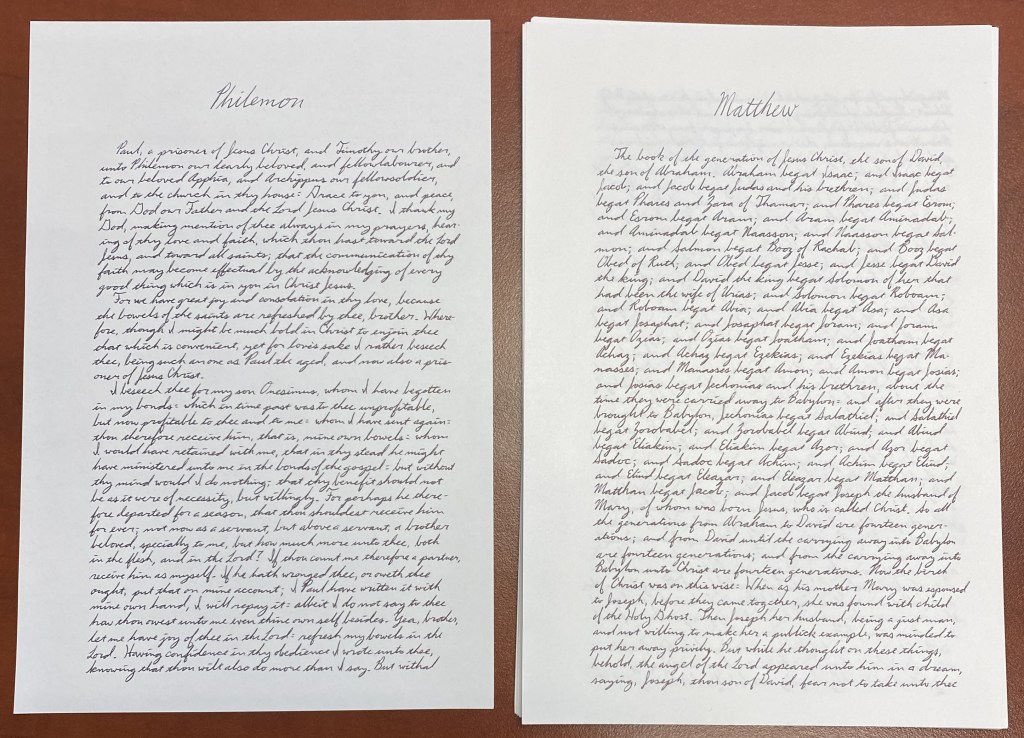
So let’s help get rid of the “for women only” misperception by defining our terms: quite simply, Scripture writing is hand-copying the Bible—writing out verses, chapters, or books into a notebook, a journal, or on some paper (or digital device) of your choosing. Scripture writing has transformed my own time in the Bible like nothing else, and you can read more about that in several other posts, which I’ll link below.
But now let’s hear from the men.
I reached out recently to several men who practice Scripture writing and asked them to share their thoughts. I was curious if their responses would be different from what I might hear from women, so I asked them to share the how and why of this practice and its place in their lives. My questions are in bold, and their responses are summarized or quoted below each question.
How did you get started copying Scripture?
Many men learned about Scripture writing online. Some watched videos, and some read blogs like my Great and Noble Tasks site or this article at Psephizo, which links back to my posts—and gave the British owner of that site the impression that Scripture writing is more widely practiced in the U.S. than it actually is. Other men were looking for a way to memorize Scripture—and found that instead they had stumbled upon a new and beneficial practice in copying the Word of God. Some men were influenced by their wives who were copying Scripture, and wanted to give it a try. And some men were simply frustrated with the way their devotional time was going and wanted to try something new—which is actually the reason I started, as well.
What method do you use?
Nathan began writing out complete books of the Bible because it was immediately measurable to him. “With the Bible being written letters and accounts, it definitely piqued my curiosity to be writing the whole letter out,” he says. “I like the benefit of tracking my progress this way, and the encouragement that even in a busy season I can ‘maintain a foothold’ with it and plod away at a larger piece (maybe just writing one verse, but still moving forward in writing an entire book of the Bible). It also makes me feel like the story is unfolding in front of me as I go.” Nathan also does something that most people don’t do: he copies in both English and German, practicing his language skills line by line and picking up on word connections and correlations.
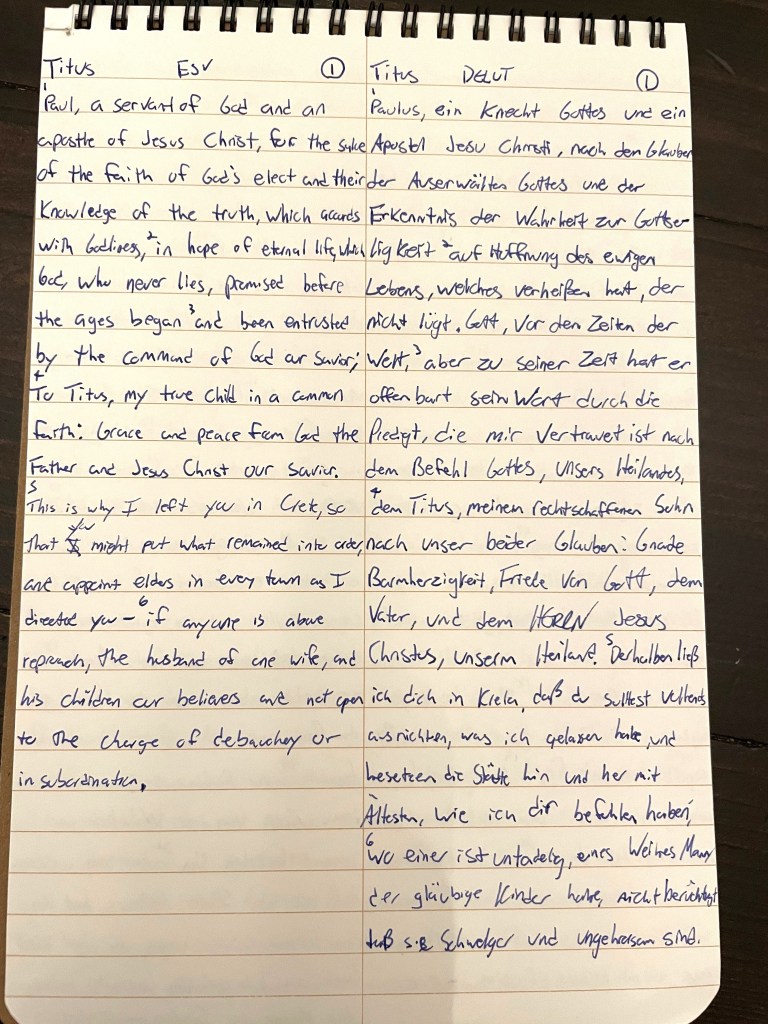

Nathan has also used Scripture writing for memory work, repeatedly copying the verse that he’s working on for Bible study.
Andy is the founder of Bible Copy Club, a free email subscription service that sends out passages and devotions every weekday for members to copy. Unsurprisingly, his current method is to use Bible Copy Club, but he began by copying sections from sermons or passages from his daily devotions. He created Bible Copy Club out of a desire for more structure in his daily Scripture writing. One interesting thing about Andy’s copying is that he doesn’t use a particular notebook or journal: “I just copy into anything—my calendar, my diary, a notebook, anything. I don’t really have a specific place that I have to copy it into. I see it as more the practice and the time taken vs having one complete journal.”
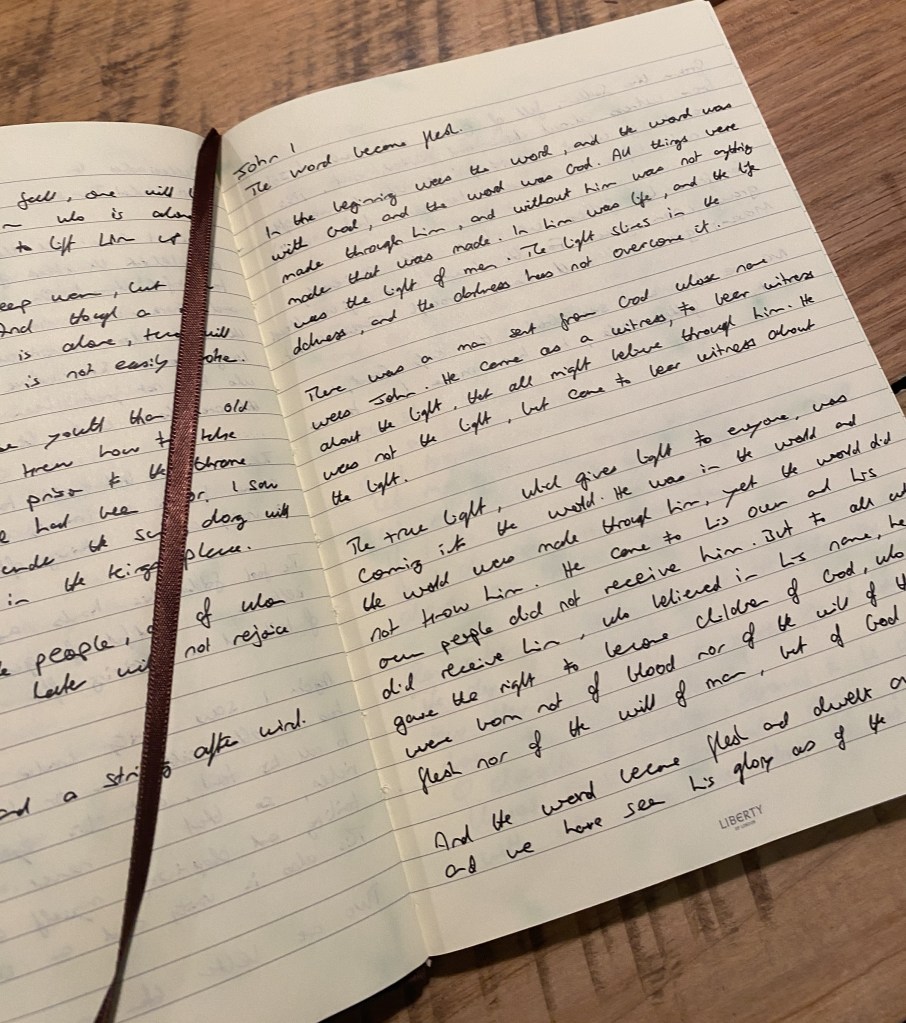
JB uses another method: the 17:18 Series from Reformation Heritage. [Note: at the time of this writing, some of these are out of stock at the publisher.] But in addition to this method, he, like Nathan, sometimes writes in another language. “Earlier this year, I bought a stack of real papyrus sheets and started writing John in the original Greek. It’s been quite a trip, but it’s been extremely educational. I recommend those that know Greek or Hebrew to do some writing in the original languages.” [Rebekah’s note: This is a great idea for those who are able—but don’t let it intimidate you if you only write in English. That’s what most people do!]
What do you feel are the most positive aspects or benefits of Scripture writing for you?
Nathan: “It helps with memorization and digesting what I’m reading to physically write it out by hand because it is not something I typically do in the normal day to day of our digital age. I think it helps with a sense of accomplishment/encouragement to be able to look back and say I read this and wrote it all out, taking at least enough time to physically write instead of getting lost in just ‘skimming’ passages.”
Andy: “Just having the time and taking the time is the most positive aspect. You think about the structure of the passages and the thought that has gone into the writing over the years, and it makes you very respectful of Scripture.”
Todd: “You really get a sense for what God is saying through his Word. There’s a clarity I don’t get as much from just reading. It’s also fun to imagine Paul and other biblical writers transferring the inspiration from the Holy Spirit to parchment.”
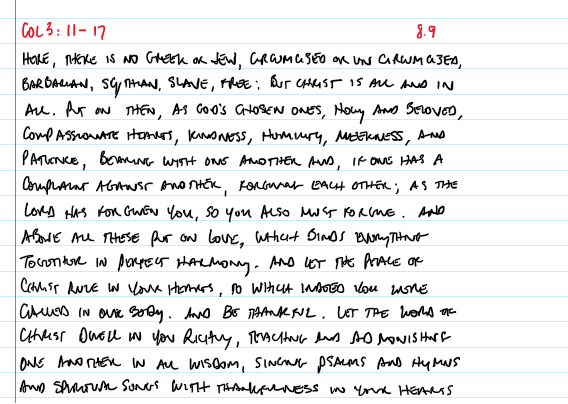
Steve: “I slow down and understand the text better.”
Jim: “Instead of just reading Scripture, I am now taking the time to listen to what it has to say to me.”
Anonymous: “I find it meditative, contemplative, prayerful, and powerful. There are lots of practical benefits too—handwriting improvement, memory, etc. Mostly I am astounded how relevant God’s Word is to my daily life. It deepens or furthers my relationship with God—Father, Son, and Holy Spirit.”
Anonymous: “Slowing down, tactile, feels like you are being active in engaging with the Bible.”
Finally, what would you say to other men about taking up the practice of Scripture writing?
Nathan: “I think men benefit from routine/habits and a sense of accomplishment, so being able to have something tangible that they can do and go back to look at is helpful. And there is a sense as a parent and leader in the home, that I hope my children can see that I care about the Scriptures and that this be observable evidence for them.” [Rebekah’s note: I’m planning a future post on Scripture writing for children, as well.]
Andy: “I think men, by and large, need a challenge. So I would advise them to set themselves a challenge to complete a book (a short one like Philemon or Jude or Obadiah) or a favorite Psalm (or even the longest one) or the Ten Commandments. You can also do a favorite passage like John 15, ‘I am the true vine.’ Pick a passage or a challenge that you could be excited about to complete.”
Todd: “Try it for 30 days. That’s typically what it takes for an action to become habit. See how it enhances your prayer life and your connection to the Lord.”
Steve: “Go slow and don’t do too much at one time.”
Anonymous: “Try it. Unless you give it a go, you won’t know what benefits, spiritual and otherwise, it will bring.”
* * *
After talking to a few of these men in more detail about Scripture writing, I observed that the things that men wonder about Scripture writing are the very same things that women wonder (or worry) about: (1) How do you find the time in your life to handwrite Scripture? and (2) How do you choose what to write?
Regarding the time commitment, depending on the method you choose, the time you spend can be as little as five minutes per day (I spend between 5 and 30 minutes each day, averaging 10 to 15). As for choosing what to write, here are three options that I like to recommend to anyone who’s beginning this practice:
1. The topical Scripture writing method that I used for three years, available free here at Great and Noble Tasks. See this post for the plans.
2. Writing out whole books of the Bible. If you choose this method, I have two different Scripture Writing Trackers in the post linked directly above (these are not necessary, but nice if you like to see a visual representation of what you’ve copied). You can also begin with well-known passages or those that are meaningful to you, as Andy suggests above.
3. An email subscription Scripture writing method such as Bible Copy Club, a free service that sends you the day’s verses to copy in the context of a larger passage that you’re copying over a longer period of time. You’ll also receive a short meditation on the passage and a closing verse of encouragement that you can copy.
Scripture writing is a valuable practice that’s worth trying for anyone—male or female—who would like to slow down, study the Bible in a new way, and write out God’s Word in your own hand. There are many benefits to this practice, but ultimately, the goal for both men and women is the same, of course: to help us understand God and his Word better, and bring us closer to Jesus.
Here are my other posts on this topic, covering different aspects of this practice, listing resources and methods, providing free plans and trackers, and more:
Ready to Try Scripture Writing?
Getting the Most Out of Scripture Writing
Why and How to Begin Scripture Writing
The links for qualifying purchases in this post earn me a small commission from Amazon, which I use to offset the costs of running this site.

 Great and Noble Tasks
Thank you Rebekah- that was very helpful! I hope to share it with my husband! Betsy
LikeLike
You’re welcome, and I hope he gives it a try!
LikeLike