
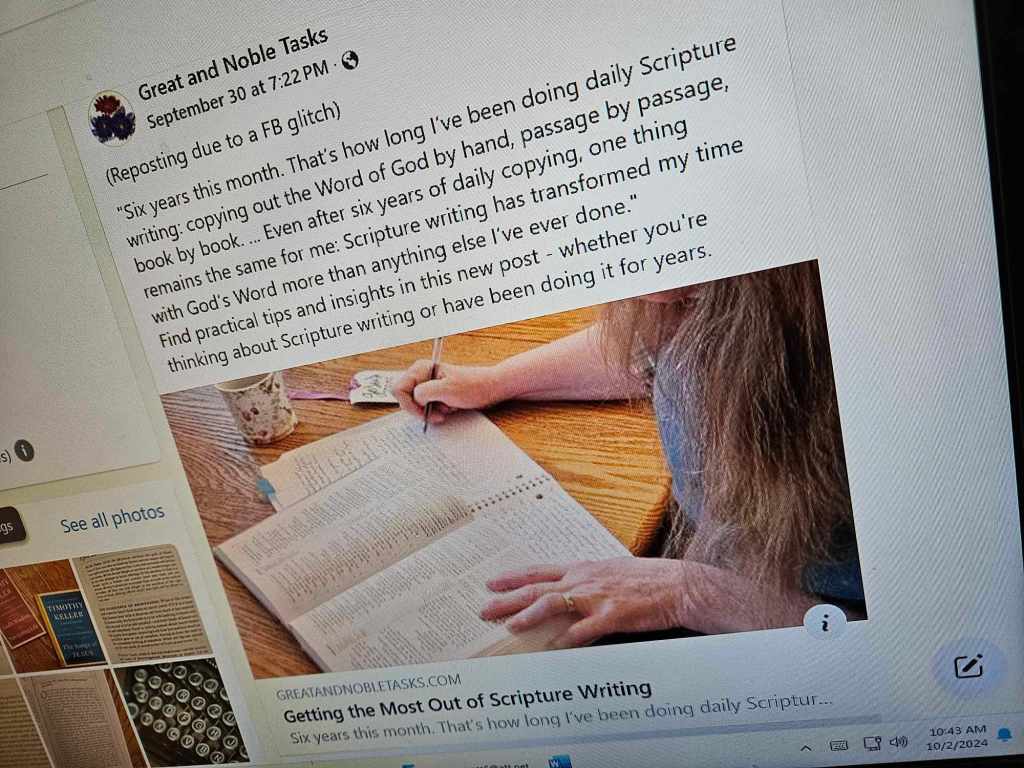
Recently I had an eye-opening experience as a result of a Facebook marketing error. I learned a few things from this glitch … about the worst parts of social media, about some people’s hatred for the Bible, and about the Christian bubble that I apparently live in, at least online.
I’ve written a couple of times about my practice of daily Scripture writing, and my first article on how to begin Scripture writing is still the most popular post on my blog. This brings me great joy, that many people have found a new way to interact with and respond to the Word of God by writing it out.
Last year, my first Scripture writing article went out on Facebook as a “sponsored post,” meaning that it was boosted to reach an entirely new audience beyond just the people who follow my page. It had such a positive outcome that I decided to boost my second post on Scripture writing, as well. I loved the idea of more people being exposed to the idea of this daily spiritual discipline that they might want to try.
And that’s when something went wrong. This time around, Meta (Facebook) seemed to have lost its ability to determine who might actually want to see Christian content in their newsfeed.
You know how it is when you see content in your newsfeed that you disagree with or don’t like for some reason, you just scroll on by (right?) and resist the urge to leave a snarky or mean comment? But of course many people on social media don’t have that kind of self-control, and unfortunately, some of those people of the atheist variety were shown my post on Scripture writing.
Almost immediately, the post got a flurry of very negative comments (everything from someone telling me to spend my time at a soup kitchen instead, to one-word comments along the lines of “ridiculous”). But even more disheartening to me were the many laughing reactions. Now after 30 years as a freelance writer, I have a pretty thick skin, and my Christian faith can’t be shaken by a few mean, Bible-hating comments on social media. But those laughing reactions on my post didn’t sit well with me because I didn’t want any readers to wonder why people might be laughing at the idea of writing out Scripture. It could be discouraging or demoralizing to someone who might benefit from learning about this. And it’s hard enough to be a Christian today without being openly laughed at for your faith or for how you choose to learn from the Word of God.
So I removed the entire post and reposted a “clean” version—sadly, losing some positive comments and reactions, as well. But I believed it was the right thing to do, and I felt relieved and calm afterwards.
I thought this uncomfortable experience was all behind me, but this was the exact moment when God threw something else in my path that caused me to think more deeply about those who openly and proudly reject him. Immediately after I dealt with Facebook’s botched attempt to share my post, I saw a random post about “books people love to hate.” It was a picture of a library display that invited patrons to place on a table any book they truly disliked—and as a pretty voracious reader myself, this idea is hugely fun and appealing to me. I love seeing what books others have disliked, and why. So even though I almost never click on the comments section of random posts, I did this time.
All of the usual “hated books” suspects were there: The Great Gatsby, Wuthering Heights, Lord of the Flies, Moby-Dick, Twilight, etc. But the book that was mentioned most often was the Bible. Such as, “Why is this entire table not filled with different translations of the Bible?”
Every time a comment like this was made, someone else (whom I assume was a Christian) would gently respond, “Have you not read it, then?” or “What about the Bible don’t you like?” And the answers were long, often irate, and full of misinformation or ignorance about Scripture. Reasons given were things like, “The Bible is full of contradictions,” or “The Bible was written and edited by multiple power-hungry men who changed it to fit their own agendas,” or “If it’s the so-called word of God, then why wasn’t the Old Testament good enough and they had to add a New Testament?” (oh, how I wish I could sit down for a talk with that person!) or “The Bible is full of violence, slavery, and misogyny—how is that a good thing to believe in?”
Occasionally someone would ask those commenters if Christians themselves (i.e., flawed and sinful people) were the problem, or the Bible in particular. But make no mistake, when people said they hated the Bible, they meant the Bible.
As I read these comments, and especially since I had just dealt with laughing reactions and nasty comments on my own post about the Bible, my stomach tied in knots and I had a leaden, sinking feeling in my chest. I felt physically anguished for those who hated the Word of God so much that they took the time and effort to tell the world about it or to ridicule a total stranger who loved it. I don’t run across this reaction to the Bible very often in my everyday life, and it grieved me.
I’d love to say that I immediately bowed my head in prayer and asked God to soften the hearts of each person whose comment I had read … but that isn’t true. I tried, but the prayer wouldn’t come. My head was reeling from all the hateful words I had just read, and it took me a day or two to process this eye-opening experience before I could legitimately pray for the many people who actively hate the Word of God. And because I had recently studied the book of John (“In the beginning was the Word, and the Word was with God, and the Word was God….”), the connection to Jesus himself was so clear and poignant to me that I had to think through a whole other layer of meaning to those comments before I could pray with a clear heart and mind.
Many years ago, quite early in our marriage, my husband was very, very close to becoming a Christian, and he struggled mightily with the idea of Christianity being the truth above all truths. I know this because he used to keep me up at night talking about the Bible, Mere Christianity, and whether Jesus must actually be the Way, the Truth, and the Life. Years later, we both laughed about those long, intense, sleep-depriving discussions. It seemed to us such a good example of how, quite often, those who have the most vociferous arguments against or about Christ just might be the very ones who are quite close to believing in Jesus and joining the family of God.
Which, eventually, was my prayer for those folks online who went out of their way to vilify or ridicule the Word—that they would actually be at the tipping point of belief, that their hardened hearts would crack so that the light of Jesus could shine in.
.
“For the word of God is living and active, sharper than any two-edged sword, piercing to the division of soul and of spirit, of joints and of marrow, and discerning the thoughts and intentions of the heart. And no creature is hidden from his sight, but all are naked and exposed to the eyes of him to whom we must give account.” (Hebrews 4:12-13)
.
“‘For as the rain and the snow come down from heaven
and do not return there but water the earth,
making it bring forth and sprout,
giving seed to the sower and bread to the eater,
so shall my word be that goes out from my mouth;
it shall not return to me empty,
but it shall accomplish that which I purpose,
and shall succeed in the thing for which I sent it.
“‘For you shall go out in joy
and be led forth in peace;
the mountains and the hills before you
shall break forth into singing,
and all the trees of the field shall clap their hands.” (Isaiah 55:10-12)
The links for qualifying purchases in this post earn me a small commission from Amazon, which I use to offset the costs of running this site.

 Great and Noble Tasks
I could not devour the words of this post quickly enough. It spoke to me and I love that you ended it with my favorite Hebrew verses! I lived in a divided home (an atheist stepfather and a Bible believing mother) and I grew up being punished for my faith. But in all that time it never occurred to me that I should be praying for my oppressor as he might be close to salvation. What an eye opener your post is.
LikeLike
I didn’t know that about your family, Bo. My own biological father was an outspoken atheist (or so I’ve been told), and I often wonder how my life might have been different had I grown up in his household. I don’t know if my father is still alive today, but over the years I’ve tried to remember to pray for him, as well – which is hard to do.
LikeLike
Thanks for this reminder to pray for people rather than get angry at them, Rebekah. I needed it!
LikeLiked by 1 person
To me, Rebekah, the haha icons and the nasty comments say more about the person clicking the haha icon or leaving a nasty comment. I have had people respond to my posts in that manner. When I have responded to those who left the nasty comment and they have replied, it has quickly become evident that te post was not so much the problem as was the attitude of the person who left the comment toward people with whom they disagree and consequently of whom they may disapprove. They often as not make assumptions and jump to conclusions based o very little information and without checking out these assumptions and conclusions. Because they disagree with someone and may disapprove of that person, they feel free to show no restraint in their criticism of them, attacking their character and making unkind remarks. This I understand is one of the effects of social media but it is also very revealing into the real self of the person making the comment. For this reason, I wouldn’t take their comments to heart as painful as they may be. Social media enables people to put their worst side on display, which they might in a face to face interaction keep hidden. It s a reminder of what poor maimed creatures human beings are, a consequence of having a sinful nature, and the magnitude of God’s grace toward us.
LikeLike