
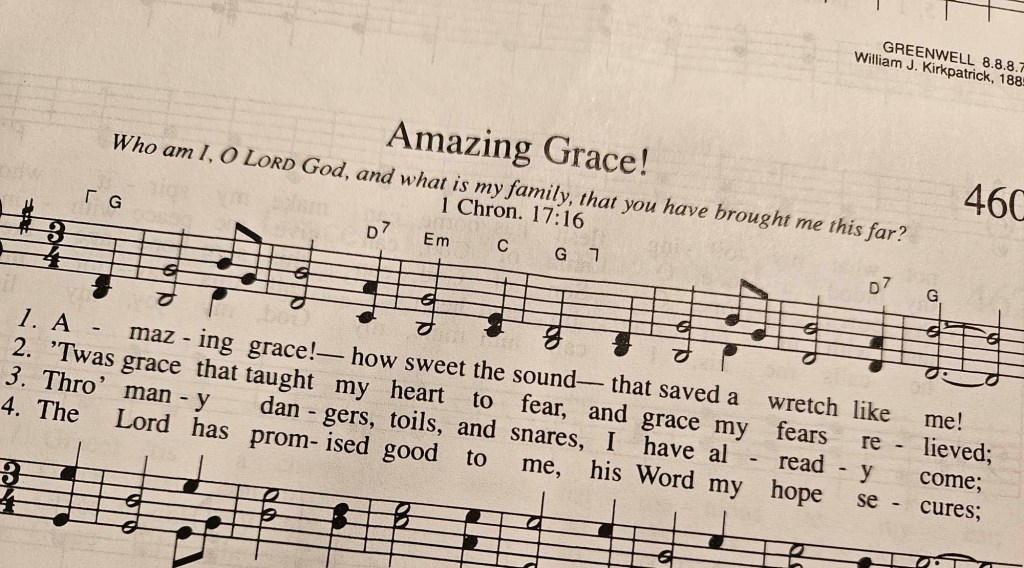
Wretch, wrath, hell, grave.
Q: What do those four words have in common?
A: They’re all words from popular Christian songs that have been removed or replaced with an entirely different word or concept.
Here’s a quick rundown of each:
Song #1: Amazing Grace, by John Newton—surely on most people’s top ten lists of the greatest hymns of all time.
The “offensive” line is the first one: “Amazing grace, how sweet the sound, that saved a wretch like me!”
Newton was a former sea captain and slave trader who had nearly died in a shipwreck. Amazing Grace has been altered numerous times in the more than 250 years since it was written. In order to excise the word “wretch,” various hymnals end the line:
“… that saved a soul like me!”
“…that freely saved me!”
“…that saved and set me free!”
(Listen to a classic recording by Judy Collins here.)
Song #2: In Christ Alone, by Stuart Townend and Keith Getty—already considered by many to be the most beloved hymn of the 21st century.
The “offensive” line is in the second stanza: “Till on that cross as Jesus died, the wrath of God was satisfied.”
The hymnal committee for a mainline Protestant denomination wanted this song in their new hymnal … but without the second half of that line. They wanted it changed to: “…the love of God was magnified.” When the songwriters refused, the entire hymn was left out of the hymnal, surely to the dismay of a great many congregants who love the song. (You can hear Stuart Townsend talk about how this song came to be here; the Keith and Kristyn Getty / CityAlight lyric video is here; and a Keith Getty interview on this subject is here.)
Song #3: I Thank God, by Jesse Cline, Maryanne J. George, Dante Bowe, Aaron Moses, and Chuck Butler. I’ll be honest: I know almost nothing about the writers or performers of this contemporary song, but when I hear it on Christian radio, I end up singing along. I especially like two repeated lines in the song that are unique and powerful, which are also the “offensive” lines: “Hell lost another one, and I am free” and the ending line, “Get up, get up, get up—get up out of that grave.”
I was recently at a gathering with 700 other Christian women, and we were encouraged to sing this song along with the band. I was familiar with the song and excited to sing it … and so disappointed when “hell lost another one” was replaced with a generic “let’s-all-praise-God” kind of lyric, and “get up out of that grave” was eliminated completely and the song ended feeling unfinished. (Maverick City Music and Upperroom perform an earlier version here, with the song ending at 5:40; and Housefires performs the current radio version here.)
Wretch, wrath, hell, grave. What’s so offensive about those words that performers and hymnal committees feel they need to remove them from lyrics? What exactly are the gospel-centered messages that people who remove these words don’t think Christians (especially younger Christians) want to hear?
I’m a wretch—unfortunate and full of sin in the eyes of a holy and perfect God. So are you. So are the singers and members of the hymnal committees. So have we all been since Adam—with only one exception: Jesus Christ, God’s only begotten son. We might like to think that sure, John Newton was wretched because he was a former slave trader, but we’re not that bad. But don’t kid yourself. We are no better than he was.
I’m deserving of God’s wrath. So are you. It’s true that God is merciful and that Jesus loves you … but God is also just, which is bad news for our sinful selves. But God loved us so much that he sent his own son to atone for our sins, to reconcile us to our holy God through the blood of the cross. We are made fit to come before a holy God because of Jesus’ sacrifice for us. Just before his death, Jesus declared, “It is finished,” and as the hymn says, God’s wrath was “satisfied.”
Without Jesus’ sacrifice for me, I would be destined for hell. Our sin is more serious than we think it is. Our God is more holy and just than we think he is. Hell is real, and Jesus talked more about hell than anyone else in the Bible. Among other things, he calls it an eternal punishment, an eternal fire prepared for the devil and his angels (Mt. 25:41-46), and a fiery furnace where there will be weeping and gnashing of teeth (Mt. 13:40-42).
I lay dead in the grave of my sins until Christ rescued me. Ephesians 2:1–2 says, “And you were dead in the trespasses and sins in which you once walked, following the course of this world, following the prince of the power of the air.” So when a song calls me to “get up out of that grave,” whether to put away the sins of my old life, or to put away the sins I’ve committed in the past hour, I know exactly what it’s talking about. Like he did with Lazarus, Jesus raises me from death to new life.
These four words—wretch, wrath, hell, grave—tell an essential part of the gospel: they tell the reason for it. Without these four parts of the story, we have no need for Ephesians 2:4–5: “But God, being rich in mercy, because of the great love with which he loved us, even when we were dead in our trespasses, made us alive together with Christ—by grace you have been saved.” Without these four challenging and convicting concepts, we have no need for Jesus at all.
Changing songs to remove these kinds of words makes for weak theology and a gutted gospel. When we do this, we’re changing the very nature of God by making him into an image of what we think he ought to be. We’re keeping God’s mercy but removing God’s justice, and when we do that, it ironically makes his mercy completely unnecessary. We’re essentially saying to God, “I think your message is a little too rough for this new generation and we really need only to talk about how much you love them because that’s all they actually want to hear.”
When I read about or experience a Christian song being changed in these kinds of ways, my mind immediately thinks of Jack Nicholson’s character in A Few Good Men, shouting, “You can’t handle the truth!” But people can handle the truth. And the truth is that when we’re pursued by a loving and relentless God, we will see clearly our sinful natures and our need for Christ. Let’s do people the favor of telling them the truth, and encouraging them to seek the truth, without first deciding that they can’t handle the truth.
* * *
“The Christian religion is, in the long run, a thing of unspeakable comfort. But it does not begin in comfort; it begins in the dismay I have been describing, and it is no use at all trying to go on to that comfort without first going through that dismay. In religion, as in war and everything else, comfort is the one thing you cannot get by looking for it. If you look for truth, you may find comfort in the end: if you look for comfort, you will not get either comfort or truth—only soft soap and wishful thinking to begin with and, in the end, despair.”
(C. S. Lewis, Mere Christianity)


Thank-you. With so many churches watering down the Gospel, this would not be a surprise. I remember the first time I heard the Getty’s–they came to my church–and I remember thinking, “Wow! YOUNG PEOPLE who actually write and sing HYMNS!” There is on You Tube a site called “Wretched,” hosted by Tod Friel. On his website he says they came up with the name because, as one of his staff said, that is how the world views Christianity. This site is Biblically sound.
LikeLike