

Neurodivergence is the water that I swim in.
As a child, I knew from a very early age that I was “different.” Different from my family, teachers, and classmates, and as I got older, different from my coworkers, neighbors, and extended family. I knew this in my heart, and I also knew it because people told me—and, especially in childhood, usually not in positive ways.
Now, “neurodiversity” wasn’t a term for most of my life, and I had to somehow define or name this thing about me, so I thought of myself as a “black sheep.” I had no other word for my differences, those things about me that I had been told to keep hidden, so that I would fit in with others, have friends, and not be so weird.
In God’s good plan, I married a man who was also “different.” Not in all the same ways that I was different, but still. He was clearly swimming in neurodivergent waters, and we had an immediate “You, too!?” connection. In retrospect, it’s not surprising that we, being two “black sheep” kinds of people, would produce children who (mostly) did not fit into the typical mold. And yet, for whatever reason, I was completely surprised and unprepared when I gave birth to a not-neurotypical child.
From the very beginning, our firstborn son cried a lot and was easily and dramatically startled. As he got older, he couldn’t tolerate loud sounds, certain clothing, and many foods. He refused to participate in many typical, kid-friendly activities. He had frequent meltdowns, both public and private, over minor things—or what seemed like nothing at all. He was highly resistant to change and had great difficulty with transitions of any kind. Rushed, tear-filled exits from church, public places, and other people’s homes became common for us, and lasted for many years.
I was a new mom and an only child who had zero experience with babies or young children, so I doubted myself at every turn. I was trying so hard, and I loved my child so much, but nothing was working and things were not getting any easier. Every day felt like walking onto a minefield. Often I would lie in bed in the early morning with tears running down my face, wondering how I was going to make it through the day, doing my best to trust in God for strength, patience, and wisdom.
My first child, in a nutshell, was different. Quirky. Challenging. Not like other children. When the pediatric neurologist ($250 out-of-pocket for 15 minutes of his time) asked me, “What one word would you use to describe your son?”, I said, “Intense.”
Our son was not neurotypical. But I didn’t know that. I knew only that I seemed to be failing as a mom.
We soon had another child, and then another. By the grace of God, these two children were “easy.” All of the simple, common-sense parenting techniques that I’d been trying and saving up and eager to put to use … they worked.
And so we had one more, our fourth. Before two years had passed, history began to repeat itself—a familiar, nerve-wracking refrain that I had thought was behind us. Almost every difficulty that we had experienced with our first, we were experiencing once more, and then some. By the time my youngest was three, I was once again exhausted and scared. And for the first and only time in my life, I was angry at God.
Angry when kneeling beside my bed, fists clenched and tears flowing, crying out to the Lord in anguish again. Angry for my own inability, again, to fix a child’s pain and make things less stressful for our family. It felt very much like I had passed an extremely grueling test by the skin of my teeth, put it behind me, and then with no warning or preparation, was given an even harder test. Many times I cried out to God, feeling hopeless, helpless, and completely overwhelmed: “I can’t do this! What is it that you want from me?”
In retrospect, I know that he wanted my trust. My obedience. My sure belief that his ways were for my good and for the good of my family. I also think that God, in his wisdom and his love and his big-picture view of my life, was requiring me do hard things because he knew that I would be forced to lean on him and call on him in order to make it through. He was also using my children to teach me many things in life that I wouldn’t have learned otherwise.
With my firstborn, I learned that my child was not a problem to be solved or fixed, but a person to be loved and understood as God made him. I came to believe in my heart that this child was given to us for a reason—because God knew that we were exactly the parents and the family that he needed. When my youngest came along, and I was overwhelmed and angry and scared, God said to me, “Do you really believe these things that I have taught you?” And over the years, I learned to honestly say, “Yes, Lord, I believe,” day after day.
During this time, I also learned to not judge others (other parents, other families, other marriages) by what I could see on the surface. I learned to love my sons’ single-minded and lengthy obsessions with vacuum cleaners, the Titanic, baseball, and origami. I learned to accept my husband’s quirks and differences with grace, and to appreciate his great strengths even more than I already had. I learned not to be ashamed of my own differences. I learned how to be a better teacher, mother, wife, and friend. I learned the value of patience, flexibility, and not giving a hoot what others think. And eventually, I learned something I ought to have known all along: that people who are different in childhood can grow up to be pretty amazing adults.
This love story is my family’s story. It’s a story about two neurodivergent people who create some other neurodivergent people and by the grace of God, make it work. A story where all the characters overcome adversity, move beyond misconceptions and misunderstandings, and realize the beauty and “rightness” of what was there from the very beginning.
Neurodivergence is the water that I swim in. Where I’m comfortable. Where I’m at home.
I wouldn’t have it any other way.
* * * * *
Resources
Individuals in our family span the spectrum (no pun intended; well, maybe just a little) from ASD to giftedness to 2e* to OCD to ADHD, as well as neurotypical. Here are some resources I’ve found helpful over the years. Some are older (because my kids are older), but all are solid and beneficial to anyone who is neurodivergent or loves someone who is.
*twice-exceptional, usually meaning giftedness plus something else
Autism Experts, founded and run by people on the autism spectrum. Tagline: “People do the best they can with the emotional capacity they have.” An excellent resource for parents, young adults, and teens.
This chart from Scientific American (2026) is excellent: “Here’s what the autism spectrum really looks like. The autism spectrum is big, vibrant and complicated, a new graphic of 39 traits shows.”
Homeschooling help for neurodivergent students can be found at:
Blog, She Wrote, for “out-of-the-box, sick, and neurodivergent teens”
Different By Design Learning, focusing on learning differences and interest-led learning
Raising Lifelong Learners, especially good for 2e students and others
Books
The Out-of-Sync Child (on sensory processing differences) and Quirky Kids (on developmental differences) were the two books I read long before I had ever heard of neurodivergence. They made me feel not so alone.
Uniquely Human: A Different Way of Seeing Autism; this book completely changed how I related to my youngest son and helped me so much after we received a diagnosis. Note: it covers the whole autism spectrum, not only HFA (high-functioning autism/Asperger’s).
Different: The Story of an Outside-the-Box Kid and the Mom Who Loved Him by Christian homeschoolers Sally (mom) and Nathan (son) Clarkson.
Differently Wired: A Parent’s Guide to Raising an Atypical Child with Confidence and Hope; again, another life-changing book for me. It’s especially good for parents of 2e kids, but is so valuable for anyone who is parenting a neurodivergent child.
Misdiagnosis and Dual Diagnoses of Gifted Children and Adults is an excellent book for gifted parents and/or children. It thoroughly covers the 2e experience and the characteristics of giftedness that can often be diagnosed as something else.
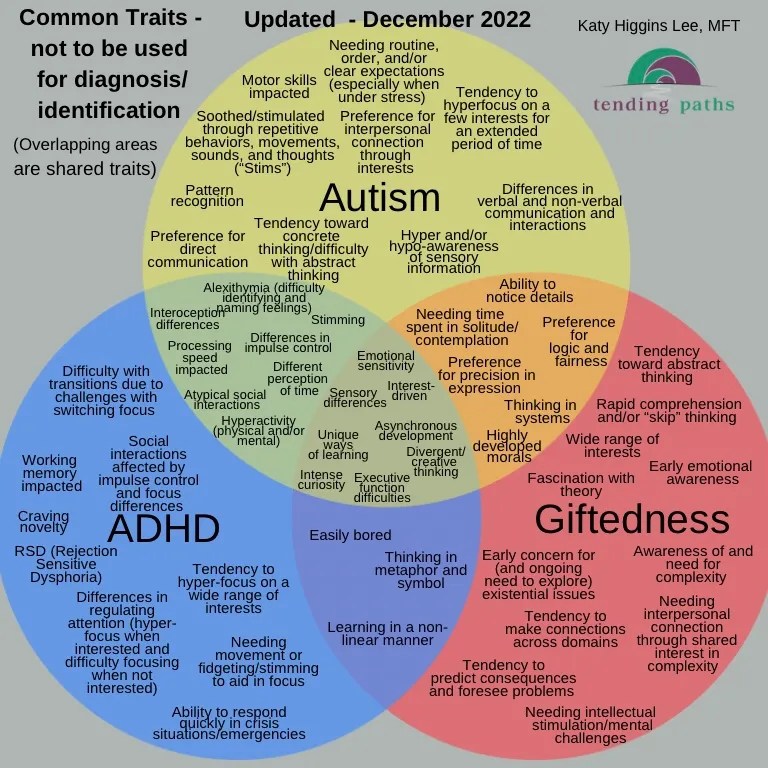
I also really like this Venn diagram, below (not intended for diagnosis) for explaining how neurodivergence overlaps and intersects. I find this absolutely fascinating and very accurate, and if you’re reading this, you might, too.
Social skills are popular to “teach” right now but I found that was easier said than done, and can’t be put on an arbitrary timetable. Still, I found that my own love of art could be used to engage my son in this important area, and I came up with Sharpening Social Skills Using Norman Rockwell Paintings.
The links for qualifying purchases in this post earn me a small commission from Amazon, which I use to offset the costs of running this site.
Photo by engin akyurt on Unsplash


Thanks so much for this providential reminder that i needed! may our great God continue to strengthen and uphold you and your husband as you shepherd your children.
Scott
LikeLike
Thank you, Scott. The Lord has indeed blessed us – even when the individual days are (or were) hard!
LikeLike
Bookmarked. I thought *my* son was the only one OBSESSED with the Titanic! In our case, our son has sensory processing disorder and probably ADHD.
LikeLike
The Titanic phase lasted a year or two here and we still have so many books and other memorabilia, twenty years later. Enjoy that time learning with him!
LikeLike
Keep going, sis.
Indeed, God made yours and mine, and we are what they need.
LikeLike