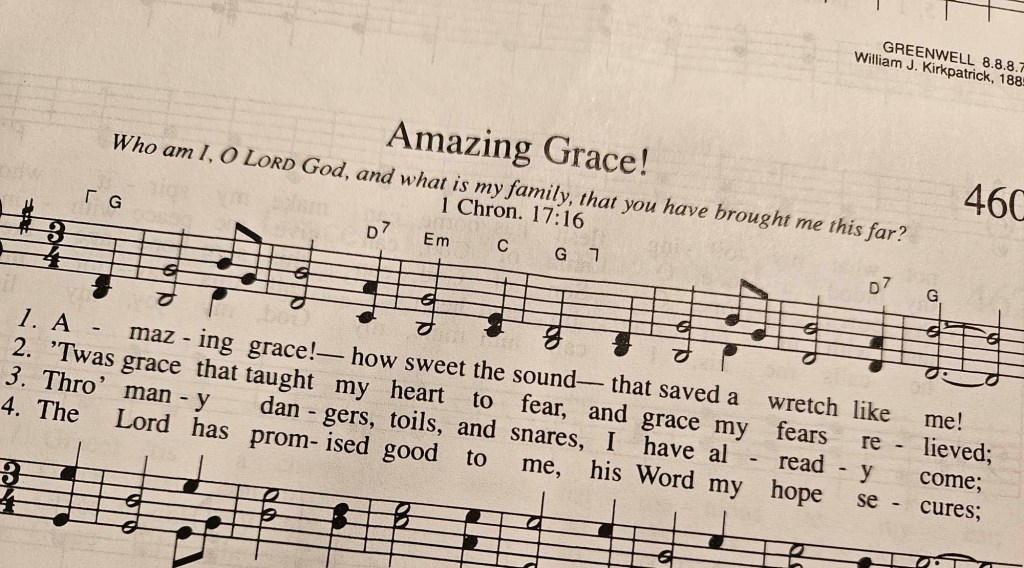
Wretch, wrath, hell, grave.
Q: What do those four words have in common?
A: They’re all words from popular Christian songs that have been removed or replaced with an entirely different word or concept.
Here’s a quick rundown of each:
continue reading"I long to accomplish a great and noble task, but it is my chief duty to accomplish small tasks as if they were great and noble." – Helen Keller

Wretch, wrath, hell, grave.
Q: What do those four words have in common?
A: They’re all words from popular Christian songs that have been removed or replaced with an entirely different word or concept.
Here’s a quick rundown of each:
continue reading
What’s more comfortable than getting up before dawn on a cold winter morning?
Staying in bed, that’s what.
But for the past couple of years (including cold winter mornings), I’ve been getting up early and going to the gym. Not every day, of course—just a few times a week. And before you jump to conclusions about the kind of person I am based on what I just wrote …
If you took into account every single year of my life up until I was in my 50s, “going to the gym” was a completely foreign and detestable concept to me. It could not have been more out of character or less expected in my life. But somehow I’ve developed this new habit, and sure enough, it’s paying off in terms of my health and fitness. Not only that, I’ve grown to really enjoy it and I miss it when I can’t go.
This article isn’t to encourage you to go to the gym, though. It’s also not about those Bible verses on the benefits of rising early (unless you want to read them—which is entirely optional: Mark 1:35, Psalm 63:1, Psalm 5:3, Psalm 119:147).
What I really want to talk about is that no-filter picture above, of a gorgeous sunrise. The sunrise that I never would have seen if I hadn’t made a difficult decision, months before, to move past my inertia and my fear of change and my feelings of intimidation.
continue reading
I love year-end “best of” reading lists. I love the ones from people whose reading tastes I mostly share (for obvious reasons), but I’m also interested in lists from people who I’m pretty sure I have very little in common with. Because a reader is a reader, and even if we are not alike in other ways, we both love books. If someone loves them enough to make public their honest year-end favorite book list, then more likely than not, I’m happy to look at it.
I only started keeping an actual “books I’ve read” list in 2018. Why it took me so long, I’ll never know. What I would give today if I had a list like this for every year of my life. If you’re not already keeping a list, I encourage you to start in 2024!
That said, here are my favorite books that I read in 2023:
continue reading
Neurodivergence is the water that I swim in.
As a child, I knew from a very early age that I was “different.” Different from my family, teachers, and classmates, and as I got older, different from my coworkers, neighbors, and extended family. I knew this in my heart, and I also knew it because people told me—and, especially in childhood, usually not in positive ways.
Now, “neurodiversity” wasn’t a term for most of my life, and I had to somehow define or name this thing about me, so I thought of myself as a “black sheep.” I had no other word for my differences, those things about me that I had been told to keep hidden, so that I would fit in with others, have friends, and not be so weird.
In God’s good plan, I married a man who was also “different.” Not in all the same ways that I was different, but still. He was clearly swimming in neurodivergent waters, and we had an immediate “You, too!?” connection. In retrospect, it’s not surprising that we, being two “black sheep” kinds of people, would produce children who (mostly) did not fit into the typical mold. And yet, for whatever reason, I was completely surprised and unprepared when I gave birth to a not-neurotypical child.
continue reading
Out of the 31,102 verses in the Bible, it’s entirely possible that you don’t necessarily like every single one of them. That some of them might actually get under your skin.
There may be a particular verse that causes a reflexive bristling or even an eye-roll—if not outwardly, then in your heart. Something that annoys you or angers you. A phrase that scares you a bit, or causes you to question the goodness of God. A verse that you choose to ignore rather than confront.
What are some Bible verses that a reader, even a Christian reader, might not like? Here are some examples I came up with off the top of my head:
continue reading
My mom’s 40th class reunion was coming up, and in preparation for that, she had to tell them her greatest accomplishment so they could put it in the program next to her name.
“It’s you,” she told me. “I’m going to put that my daughter is my greatest accomplishment.” Then, with matter-of-fact truthfulness, “I don’t have anything else to put anyway, but even if I did, I would put you, because you’ll always be my greatest accomplishment.”
We were talking on the phone when we had this conversation—her in a recliner in the living room of her trailer, with a book in her lap and a cat on the nearby couch; me in my tiny kitchen, tethered to the wall by a stretched-out phone cord, stirring a pot on the stove and keeping one eye on my toddler and preschooler.
It wasn’t the first time I’d heard her say this, but I’d never really understood it. What did she mean, I was her “greatest accomplishment”?
continue reading
Shared interests are one of the best things about having kids.
At some point, Lord willing, they will begin to love something that you love: Hunting or fishing. Gardening or cooking. Baseball, running, or golf. Cars, trains, or motorcycles. Concerts, movies, or video games. Dogs, cats, or babies. Crocheting or carving wood. Those times when you bond with one of your offspring over a shared love of [whatever] are some of the priceless payoff moments of having children, for sure.
My mother and I both loved to read—we bonded over books we discovered together, books we gave to each other, books we couldn’t wait to discuss, books that inspired us, puzzled us, and made us swoon. My mom and I didn’t have much in common, but from my childhood through my mid-forties when she passed away, books were our common ground.
So naturally when I had a daughter of my own, I eagerly anticipated sharing books together, reading in tandem, and the wonderful discussions that would follow. (I just assumed she’d be a reader; the possibility of two book-loving parents having a child who did not even like to read never once entered my head back then.)
continue reading
Have you ever been through a church dissolution? Either a church you helped start from the beginning or you were simply present at the end?
I have.
Twenty years ago this month, my family was part of a core group that planted a church. Forty-seven people were bound together by shared dreams, exciting plans, multigenerational camaraderie, a love for the gospel, and high hopes for what we envisioned years down the road: a strong, healthy congregation, a building of our own, and God’s Word being preached, taught, and shared with others. God was doing a good work, and we had the incredible opportunity to be his hands and feet, establishing a new church in a new place for his glory.
continue reading
Once upon a time, I was an actor. Before I was a Christian, before I was a wife and mom, before I was a teacher, before I was a writer … this goes way back—high school and early college.
During those formative and tumultuous years, theatre was just about my whole life. It got me through high school in one piece, and it gave my life purpose and meaning. The stage was home to me.
After auditions, we actors would wait breathlessly for the cast list to be posted. We all had an idea of the role we really wanted. Sometimes we wanted the lead role, but not always. Sometimes we yearned for the smaller but more interesting role, or the role that would be more “fun” to play.
The “fun” roles were, as you might suspect, quite often the role of the villain, the antagonist, the person who causes friction or trouble of some kind. The person who has deep troubles or desires or motivations that are not … nice. Those roles are interesting, and if I were a psychologist I could probably write an article on why those roles are so interesting, but instead I’m just going to tell one story about one role in one play.
continue reading
“Believe in yourself.”
If you want to hang this inspirational phrase on your wall, wear it on your body, use it for your lock screen, or stick it on your water bottle, you’re in luck:
“Believe in yourself—you are enough”
“Nobody will believe in you unless you believe in yourself”
“If you believe in yourself, anything is possible”
“Believe in yourself and you will be unstoppable”
“She believed she could, so she did”
These are five immediate results I found on a recent image search for “believe in yourself.” They’re nice ideas, aren’t they? It’s good to believe in ourselves, to have self-confidence and stay focused, to have self-esteem and a “growth mindset.” Surely that kind of positive determination will serve us well in life, setting us on the path to achieving our dreams. It’s likely you’ve even seen evidence of this in your own life or in the lives of others.
Why, then, is “believe in yourself” an idea you won’t find, in any form, in the Bible? Why does Jesus, in all his words of wisdom, never once even remotely hint at anything like the ideas above?
Instead of believing in ourselves, Jesus tells us to believe in him. Instead of trusting our own hearts, he says to trust in God. Instead of believing that we are enough for the world, he says that he is enough for us.
“But,” you may say, “when you say, ‘believe in yourself or trust in God’—isn’t that a false dilemma? I think I can do both. In fact, I think I ought to do both—believe in myself and trust in God!”
Okay, yes. You can do both. For a while.
continue reading