
I never read The Chronicles of Narnia as a child. In fact, I don’t think I had ever even heard of C. S. Lewis until I read Mere Christianity when I was nearly thirty.
Ten years later, I had three (almost four) children, and I read The Chronicles of Narnia aloud to them during lunch, as a part of our homeschool day—one of a very long line of lunchtime read-alouds with my kids. When I read Narnia that first time, my brain was partly engaged in the story as you would expect, but partly I was in teacher mode as I was with all read-alouds: Do they know the meaning of this word? Do I need to explain this scene? Is this sentence something I need to verbally edit as I go? Can we get to the end of this chapter before the 5-year-old runs out of food? When I close the book, is there anything we ought to talk about before they leave the table?
So yeah, I was distracted. I remember appreciating the story, though, and discussing the Christian allegory aspect with my children.
In the Narnia books, grown-ups are not allowed to enter Narnia from our world (the exception is that when Narnia is created, two adults are a part of that). When Narnia needs help, certain children from our world are called by Aslan to assist; then around the time they reach adolescence, they are told that they can’t return. How wonderful to be a child reading Narnia for the first time, imagining what it would be like if you, too, were one day called to assist this magical place of Talking Beasts, naiads and dryads, centaurs and fauns, and High Kings and Queens.
But alas, at my age, I’m too old for those kinds of dreams, in more ways than one. Still, I wanted to revisit Narnia as a grown-up, just for myself. Not as a teacher, not as a mom, but just for me. My questions going into this reading were (1) What would I think about the books as an adult, and (2) What affect, if any, would the reading experience have on me?
The first thing I discovered, long before I even finished the first book, is that they confirmed Lewis’s own quote: “No book is really worth reading at the age of ten which is not equally—and often far more—worth reading at the age of fifty and beyond.” If you enter Narnia through the wardrobe (as you should; see my note at the end of this post on the numbering of the books), you find almost immediately that The Lion, the Witch, and the Wardrobe is just astoundingly good writing, as both a children’s book and a Christian allegory. Every word is perfect, nothing is wasted, there’s both humor and very serious subject matter, it moves quickly, and the characters (as we might say in the 21st century) are “relatable” for both children and adults.
So the answer to my first question, what would I think about the books as an adult, was easy. Lewis writes for children the same way he does for adults: with exceptional skill and wisdom. When he’s writing for children, he respects his readers’ intelligence, their sense of adventure, and their innocence, all at the same time.
Of course, as an adult, I have intelligence and I still have a sense of adventure … but innocence? Not so much anymore. And yet … I found that Lewis’s respect for his readers’ innocence was the key to my second question: What affect, if any, would the reading experience have on me?
Now, I do most of my reading in the evening, before I go to bed. Usually, I put my book down and then don’t think about it much again until the next evening or the next time I pick it up. Not so with my visit to Narnia.
The effect that these books had on me (especially The Lion, the Witch, and the Wardrobe and the end of The Last Battle) was this: when I settled into bed each night, I felt something unusual deep inside that was a direct result of my reading—a strong but pleasant feeling, an overwhelming sense of peace as I drifted off to sleep. It’s very difficult to put into words, but I felt as if my soul was stretching out towards God. I had a physical yearning to be in his presence and I felt a great longing for my true and eternal home.
More than once during the three weeks that I was reading the Narnia books, I recalled this passage from the Bible: “As a deer pants for flowing streams, so pants my soul for you, O God” (Psalm 42:1). In all of the times I’d come across this verse or heard it in church (I’m going to be very honest here), I had never truly felt what the psalmist described. I had never felt that my soul panted for God as a thirsty creature pants before a cool mountain stream. I knew I loved the Lord, but I wondered if something was wrong, that I didn’t feel this desire as a strong thirst in my soul or in my heart.
But when I read Narnia, I did. And I have a theory about why this is.
Although written for children, The Chronicles of Narnia centers around topics of immense and everlasting importance, telling the story of Creation, Fall, Redemption, and Restoration in a creative and biblically sound manner. But there’s something else going on in these books—qualities of storytelling and universal human desires that are at the heart of the best, classic children’s fiction:
> Honesty. Sincerity. Earnestness.
> Longing and yearning for something meaningful and something more.
> Whimsy and genuine, clean humor.
> Honor, integrity, and noble character.
> Repentance. Forgiveness.
> Equally respected, and sometimes different, expectations and roles for girls/women and boys/men.
> Bravery. Selflessness.
> True justice and real mercy.
> A clear knowledge of the existence of good and evil, choosing what is right, and a willingness to pay the cost.
For those of us who are Christians, and despite the dysfunctional world we live in and our own often sinful lives, our hearts instinctively know Truth and Beauty. Our souls long for our Savior and the perfect goodness of our eternal home. So we respond, in a familiar and comforting manner of childlike innocence, to characters and stories that exhibit the traits and themes above—because they reflect our heavenly Father and Christ himself. When we encounter books like this, we find ourselves responding not with contemporary attitudes of eye-rolling irony, but instead with a heartfelt, “Yes! I knew it all along!”
The Chronicles of Narnia books are unabashedly and unapologetically sincere, earnest, honorable, and hopeful. Yes, they’re children’s books, but they’re thoroughly “grown up” in that they point to the universal truths that Christians instinctively yearn for and know in our hearts, minds, and souls to be true. As someone who reads a lot of books, including current fiction (I try to read only the best new fiction, but still), I have to say that my visit to Narnia was like a breath of fresh air, a drink of cool water, and a reminder that this world’s story isn’t over yet, and there is a much bigger and better story yet to come.
.
“And calling to him a child, he put him in the midst of them and said, ‘Truly, I say to you, unless you turn and become like children, you will never enter the kingdom of heaven’” —Matthew 18:2–3
“If I find in myself a desire which no experience in this world can satisfy, the most probable explanation is that I was made for another world.” —C. S. Lewis, Mere Christianity
.
[Regarding the numbering of the volumes in The Chronicles of Narnia: I own two boxed sets, one old version with the original, publication order numbering (beginning with The Lion, the Witch, and the Wardrobe), and one otherwise lovely 50th anniversary edition with the new numbering (beginning with The Magician’s Nephew). I strongly encourage you, at least for your first reading, to enter Narnia through the wardrobe with the original numbering system. Reading them in the newer, chronological order “gives away” many details that are so delightful to discover later, in the actual order that Lewis wrote them. These are wonderful, magical “a-ha!” moments for readers of any age. The vast majority of readers who love Narnia are appalled at the renumbered editions and ignore the new numbering. Here’s a very good article (it has spoilers) with many more details about how the books got renumbered back in 1994 and why you should read them in the original order, at least the first time.]
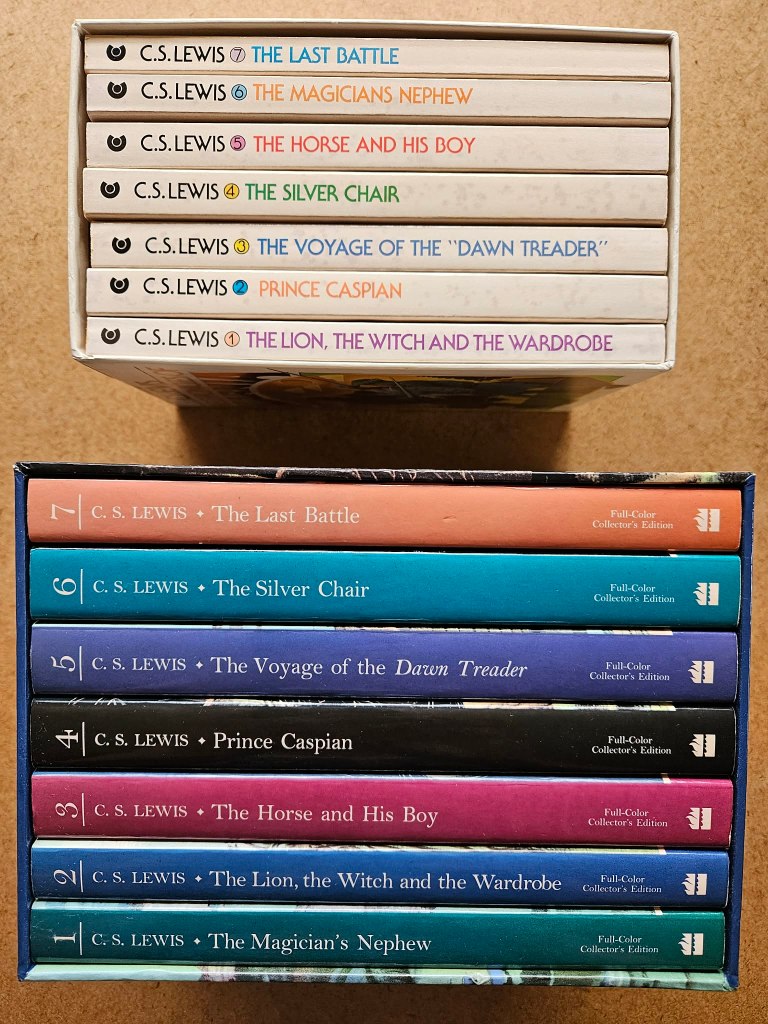
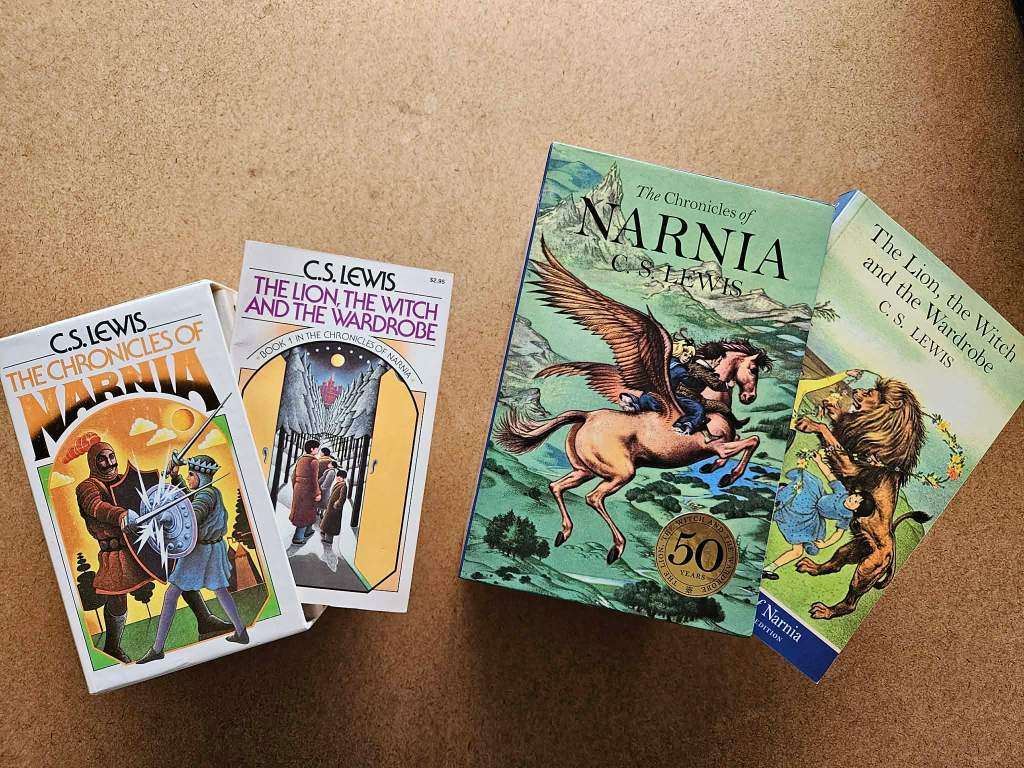
Image by Jürgen from Pixabay

 Great and Noble Tasks