
One of the good gifts that God gives to his children is the gift of time. How do you use yours? Do you use it wisely and with a clear conscience, at least most of the time? Or (be honest, now) are you scrolling it away?
For the past several years, I’ve been feeling more and more convicted about how much time I spend on my phone. When I say “convicted,” I mean it seriously. I’ve felt like the Holy Spirit was nudging me to evaluate my online habits (in particular, mindless scrolling and compulsively checking my phone), call them out for what they were (a waste of my God-given time), and change my behavior for good.
For most of my life, I’ve generally made pretty good use of my time. It’s only been in the last few years that I’ve felt that I’ve had a problem in this area, and have sometimes felt actual shame over it. I took a good, honest look at my phone’s role in my daily life, from the time I woke up until the time I went to sleep. Here’s what I saw in my mind’s eye: me, on the couch or standing at the kitchen counter or sitting in a parked car; head bent, nearly immobile, eyes fixed on a small, black rectangle as I scrolled out of habit, oblivious to my surroundings and finding it difficult to tear myself away. The continual dopamine hits fueled my pointless (in)activity as the minutes slipped by, unnoticed.
Was I watching or reading something awful, something “bad” for me? No, the content wasn’t the issue (although the questionable content on social media deserves its own post, for sure). It was the time that was the problem. Don’t we all know, in our hearts, that scrolling social media isn’t the best use of our time? In fact, in many ways, it’s a terrible use of our time. “Children and teens are addicted to their smartphones!” we say, and yet, are we adults not in the same boat?
How and Why I Stopped the Scrolling Habit
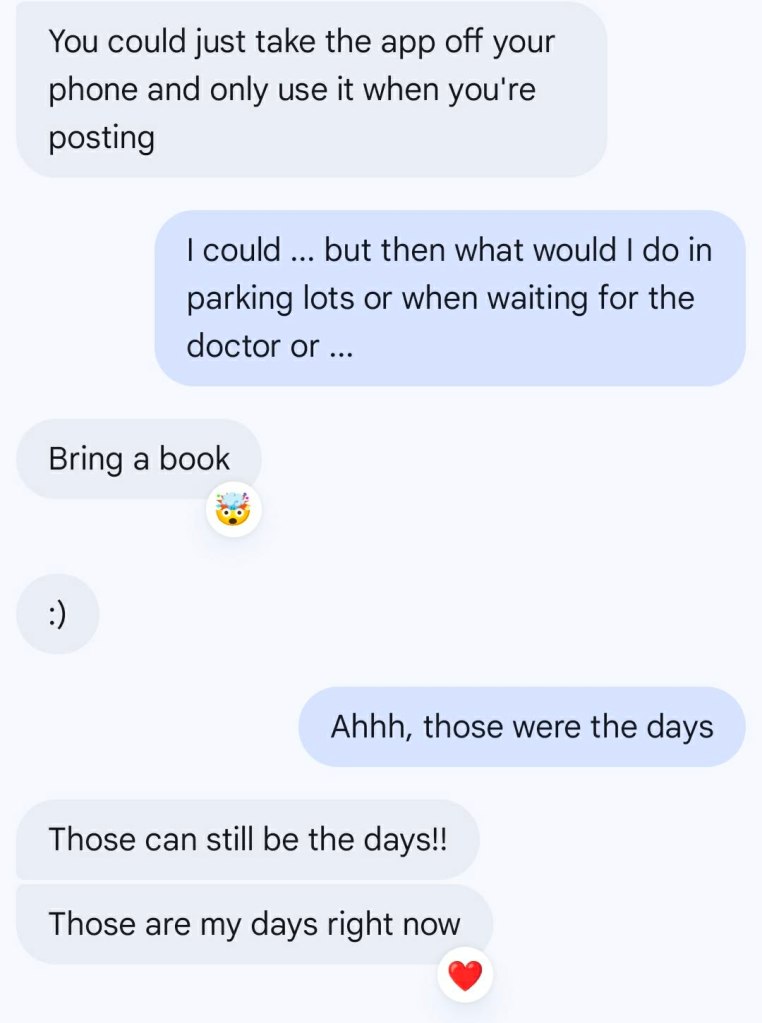
After recently slogging through an increasing amount of manipulative AI content (which depresses me to no end), in addition to the usual negative or rude comments that are a given online, I somewhat impulsively texted my 27-year-old daughter and told her that I was considering removing Facebook from my phone. I actually forgot that she had completely deleted all social media from her own phone some time ago.
Here’s the beginning of our text conversation:
As a digital native, she’s thought through technology’s effect on our lives quite a bit: “I feel like the most common attitude about phones is that they’re a necessary evil. People don’t always realize how unnecessary the evil actually is, because we’ve accidentally built our lives around it.” She has never once regretted removing all scrollable apps from her phone several months ago. This includes all social media (for her, Pinterest was a huge problem, for me it’s Facebook, for others it’s Instagram or TikTok or X or Bluesky… you know your own weakness) and all mobile games. She kept YouTube and Amazon because they’re not problems for her and she uses them wisely and intentionally.
She continued, “I thought I would miss the apps, but it’s so glorious to be free. I draw more, I read more, and I play more real video games (games that are art and story vs. mobile games that are designed only to steal your attention and convince you to spend money), and my attention span is noticeably longer for all those things. I’m more capable of sitting with boredom instead of feeling like I have to be entertained every single second. I feel like I’m choosing to do things rather than just defaulting to the easiest thing every time I sit down.”
So what does one do when habitual scrolling is no longer an option? One current trend is to put together an analog bag that is essentially just a tote bag for your home or car, containing a book or magazine, craft supplies, puzzles, games, a journal or sketchbook, nature guides, etc.—whatever you like to do that doesn’t involve your phone. If you’re older, think back to what you might have done to pass the time before 2005. I’ve started bringing a book with me again if I think I’ll have a chance to read while I’m out. Also, in my car’s console, I’ve stashed a portable book of puzzles with a pen and highlighter, a small pad of paper, a cheap paperback Bible, and I might throw in a book of short stories or a magazine. I love interacting with a variety of real objects again, rather than defaulting to my phone.
My New Relationship with Social Media
I don’t plan to abandon Facebook entirely, for lots of reasons. But now that I don’t use it on my phone, I need to be at my computer to access it easily. Just like the old days when you’d sit down at your home computer to go to the internet, I have to go the room where social media resides (my office) and I have to choose to use it. When I made this change, I wondered if I’d just start mindlessly, endlessly scrolling while sitting at my desk. Nope. I’m not tempted one bit to do this, even though I still visit Facebook on most days, and I still post and interact there. Social media is no longer a reflexive habit or a way to “relax” or a way to kill time. And when I leave the room … poof! I leave it behind me, because now it lives on my computer and it doesn’t follow me around everywhere I go. I can’t even describe how freeing this is.
As for scrolling social media in order to relax, I think that this is an illusion. Addiction to your phone is never actually relaxing. It’s just habitual. My daughter puts it this way, “It feels nice because you can quiet your brain, but then you’re just filling that space with garbage noise and ads [for me, that would be garbage AI and negative posts and comments], which isn’t better, and usually made me feel even more stressed when I would stop, which made me want to never stop. It’s an addictive cycle, and the apps know that and they’re doing it on purpose.”
They are indeed doing it on purpose. We all know that social media is carefully designed to create dependency, or—let’s call it what it is—addiction. And while it’s acceptable to acknowledge that too much screen time is addictive and destructive for brain and social development in children and teens, we have a very hard time admitting that this is true for adults, as well.
I Worried About Making This Change, But I Shouldn’t Have
It’s so easy to underestimate or explain away how much time we actually spend online. When you’re scrolling, it feels like you’re doing multiple things, keeping your brain active and involved while changing topics with every post. But to someone watching you, it looks very different (picture it in your mind—we all know what hypnotic, phone-scrolling lethargy looks like). And it was only when I began to see myself as if from the outside—how others would see me, or how God would see me— that I realized I needed to do something about it.
And honestly, giving up scrolling on my phone was easier than I thought it would be. Within just a couple of days, I felt freer and had almost zero anxious FOMO (fear of missing out). I realized quickly that my phone hadn’t been helping me relax at all. In fact, without checking my phone frequently or staring at it for long periods, quite the opposite happened: I felt calmer, my mind felt quieter and more at peace, I felt more connected to my surroundings and in tune with those around me, and I just felt more present in my own life. I moved from one thing to another without needing a “break” with my phone or needing to check whatever it was that I used to compulsively check. I feel like I got some of the “old me” back, in the best possible way.
I thought I would miss scrolling social media on my phone. But I don’t. I have zero regrets.
What Finally Drove Me to Make This Change
I’m currently copying the book of Luke in my daily Scripture writing, and I recently wrote out Luke 12:48b: “Everyone to whom much was given, of him much will be required”. For the first time in my life, I saw that verse as talking about time, as well as about gifts, money, or talents. God has given us time; what are we doing with it in this digital age?
I’m also reading an excellent book about heaven right now, which has made me think more about what will happen when my time on this earth is done. Here’s something I was reminded of, and I’m not going to sugarcoat it: we will give an account of our use of the time that God has given to us.
“So then each of us will give an account of himself to God” (Romans 14:12).
“And I saw the dead, great and small, standing before the throne, and books were opened. Then another book was opened, which is the book of life. And the dead were judged by what was written in the books, according to what they had done” (Revelation 20:12).
And finally, I remembered that “whoever knows the right thing to do and fails to do it, for him it is sin” (James 4:17).
The fact is, I had a problem. The world wouldn’t say that I had a problem, but I could see it for myself when I took a step back and looked, and I knew the compulsive feelings that were driving my behavior. I needed a course correction in my life, and my Scripture writing, my current reading, and my daughter’s example all came together to convince me to do what I needed to do.
I’ve been alive for six decades now. God has been so gracious with the time that he’s given to me, and I know that how I use it matters.
.
Currently in 2026, people of all ages (U.S. and globally) spend somewhere in the range of two to five hours per day scrolling social media on their phones. The average time spent on social media is around 2.5 hours per day (about 18 hours per week, 75 hours per month, 900+ hours per year). You can find more specific information on demographics, specific platforms, and consequences of social media scrolling here and in many other places with a quick online search.
The links for qualifying purchases in this post earn me a small commission from Amazon, which I use to offset the costs of running this site.
Image by Martin from Pixabay

 Great and Noble Tasks
One thought on “Why I Ditched My Scrolling Habit, and What I Got in Return”