
When I was in college, I worked in a mall bookstore—to this day, one of the best jobs I’ve ever had. As the assistant manager, I’d often arrive early to get some paperwork done before other employees arrived.
If you’ve ever wondered whether bookstore or library employees can read on the job, the 1980s answer is yes, to a certain extent. I often took advantage of this perk, and when I was in the store by myself, I could gravitate toward those books that I might not want others to see me reading. Alone in the store, with 15 minutes to do with as I pleased, I often headed for the Religion and Bibles section.
I wasn’t a Christian at the time, or even especially spiritual. As a young child, I’d read a 10-volume children’s Bible that had caused me to declare Jesus as my savior, but that commitment only lasted a few years. By the time I worked in the bookstore, God was a distant memory and Jesus was far from my mind and my life … or so it seemed.
The Religion and Bibles section was almost entirely ignored by the bookstore employees, except when we needed to direct a customer who asked about it. We stocked new age guides, texts from world religions, and Christian books by authors like C. S. Lewis and Billy Graham, among others. But I wasn’t much interested in any of these books. What I gravitated toward—in secret, mind you—was the Bibles.
My own experience being limited to an illustrated children’s Bible many years before, I was very curious about what a “real” Bible actually was. We carried the King James Version, of course, along with the New King James, the Revised Standard Version, The Way (the teen version of the Living Bible), the Good News Bible, and the more recent New International Version. I had no idea what any of those names meant, but to me, they all had one thing in common: although they fascinated me, they were also very intimidating.
What makes the Bible so intimidating? Here are some of the things that were running through my mind as I furtively examined Bibles, alone in the bookstore:
- The Bible is huge—more than 1,000 pages. Even on nearly transparent paper (also weird and unfamiliarly fragile), it’s a big book.
- The Table of Contents isn’t very helpful, being filled with unfamiliar names and words that cryptically identify either the topic (Genesis, Exodus; Revelation); the author (James, Ezekiel, Isaiah); the individual recipient (Titus, Philemon); or the geographic, collective recipient (Philippians, Colossians); not to mention the inexplicable numbering (1, 2, 3 John; 1 & 2 Timothy; 1 & 2 Corinthians) and words to stumble over (Thessalonians, Leviticus, Deuteronomy, Ecclesiastes, Haggai). Seeing these sixty-six “book titles” for the first time, I had no idea how to even categorize them.
- The layout isn’t very reader-friendly, at least in those 1980’s Bibles. I saw page after page, column after column of small, dense text. Sure, there were numbers everywhere (chapters, verses), but what do those even mean?
- The references and cross-references are confusing. Why is there a center column with lots of abbreviations and numbers? I distinctly remember seeing that particular feature as a young adult and I immediately concluded that I would never be able to understand this book.
- There were, at the time, random words in italics that, when you emphasize them as one does with words in italics, it makes no sense. This was a much bigger issue back in the day, when King James Bibles regularly put words into italics that the translators had added to help the reader, such as Genesis 1:4, “And God saw the light, that it was good.”
Now, in the last forty years, many Bibles have become more readable and user-friendly, in terms of layout, design, and “helps” alongside the text. This is a good thing! But even years later, as a new Christian, I found that comfort and familiarity with the Bible didn’t just “happen.” There were even more speed bumps on the way to understanding and knowing the Bible as a new believer:
- The Bible isn’t necessarily best read from front to back. Halfway or so through Exodus, things get more difficult (let’s call it what it is: more boring), and by the time you’re well into Leviticus, you’re likely to quit altogether. Histories repeat themselves (as do the Gospels), prophets are out of context and not in any sensible order, and vision-filled books such as Ezekiel and Revelation are downright bizarre.
- When you’re unfamiliar with the Bible, your secret is always in danger of being exposed. When the pastor or Bible study leader says, “Turn with me to Hosea” or Galatians, or 1 Thessalonians, or Ezra, how fast can you get there? Not very.
- Which translation to use? Are some translations better than others? Will I be judged for the translation that I choose?
For someone unfamiliar with the Bible, it can seem like a strange and scary book, intended only for insiders, for people “in the know.” It almost feels designed to intimidate, to separate the “real” Christians from those who are only just pretending.
As a new Christian, I knew in my head that none of those things were true—surely God wanted us to read the Bible, so he didn’t deliberately make it intimidating or difficult. Still, not having grown up with Bibles in my house, or with parents who read it, or with hearing it in church, or with any knowledge of it beyond a short-lived, childlike acquaintance, I needed to acquire some kind of strategy for familiarity in order to fully understand my newfound faith.
Over the years (especially the first five or ten years of being a Christian, starting when I was around 30), I found several ways to make the Bible more understandable and usable; more like a good friend who I wanted to get to know better, rather than an intimidating book that I struggled to understand. Here are some things that helped me along the way:
- As with any relationship, spending time together is the key to true knowledge and familiarity. There’s no substitute for reading your Bible as often as possible—ideally every day. Following a good one-year or three-year plan is a great way to begin. It’s also important to not get discouraged with the parts you don’t understand or that bore you. As time goes on, you’ll understand more and more. If you attend Sunday school, use a study Bible, or participate in other Bible-related classes in your church or in your community (such as Community Bible Study or Bible Study Fellowship) understanding and familiarity will follow. Pro tip: When you miss a day or two—and you surely will—don’t get discouraged. Jump right back in no matter how many days you’ve missed. If you try to “catch up,” that may never happen and you’re likely to quit altogether.
- Take a cue from children’s Sunday school and learn the books of the Bible, in order. As a new Christian, I sometimes sat with my children in their Sunday school music class, and it was during that time that I received one of the most valuable and practical gifts ever given me by a church: I learned the books of the Bible in order, using this song from Wee Sing: Old Testament and New Testament. Even today, and I say this with no shame, I sing relevant parts of these songs in my head whenever I need to find many of the less-obvious Bible books quickly.
- Are you a more auditory learner, or do you have time on your hands in the car, when working out, when on nighttime baby duty, or when doing chores? Try listening to the Bible. Hearing the whole Bible read aloud is a valuable and time-honored practice. Here are some options you might want to try—almost all are free; website and/or apps:
- Daily Audio Bible
- Bible Gateway (David Suchet, among other readers)
- The Word of Promise
- Dwell (subscription)
- Blue Letter Bible
- YouVersion
- Streetlights (hip hop soundtrack)
- Bible in a Year
- Try a Bible intended for those new to the Bible. When my husband and I became Christians, the first Bible we bought was the Quest Study Bible. I love this Bible because it has thousands of questions and answers in the margins—questions that nearly every new reader would have, as well as those you might never have thought of. It was a tremendous help to us as we familiarized ourselves with this long and unfamiliar book. I highly recommend it for new or still-curious believers. We also gave a copy to each of our kids to use during their teen years (there’s a teen edition, as well, but we just gave the regular version).
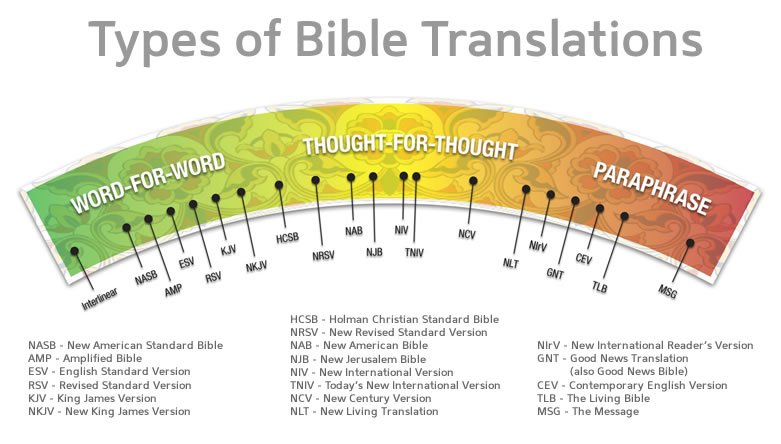
- Choose a translation and stick with it for a while. (My go-to Bible is the ESV—I love the Reformation Study Bible, specifically—but I also use the NKJV and occasionally the NIV and NLT.) Over the years, you’ll likely try a few others, or at least compare different translations online (this is very easy to do with websites like Bible Gateway or Blue Letter Bible). I’ve placed a helpful chart of Bible translations below. Be sure to steer clear of paraphrases until you’re already very familiar with the Bible—if even then. And once you’ve already read the Bible using a regular reading plan, you might want to try a chronological Bible (this is the NLT that I really enjoyed; there’s a chronological ESV now, too) for a helpful and interesting new approach.
- Watch a video overview of each book before you begin, or after you finish. BibleProject has created highly informative, engaging, and visually appealing animations of the entire Bible (Old Testament and New Testament).
- Grab a chapter-by-chapter guide, or another reference book to help you understand what you read. My favorite go-along is With the Word, which is a chapter-by-chapter guide that I love to recommend—I use it even now alongside my daily Scripture writing. Other excellent guides are The Bible Recap and the classic What the Bible Is All About (several versions available). I also recommend A Visual Theology Guide to the Bible for reader-friendly, full-color explanations of all aspects of the Bible, great for teens and adults.
- Pray about it. Ask God to help you understand his word and open your heart and mind to whatever it is that he would have you notice and learn. Make a habit of this every time you open the Bible.
The Bible can be intimidating—I know that firsthand. But reading it, spending time with it, learning more about it, and praying for God’s help to understand it will pay off, I can promise you that. If you or someone you know is feeling a pull toward reading the Bible or returning to it after an absence of many years, as I felt that pull all alone in the bookstore many years ago, know that God put that desire in your heart for a reason:
“For as the rain and the snow come down from heaven
and do not return there but water the earth,
making it bring forth and sprout,
giving seed to the sower and bread to the eater,
so shall my word be that goes out from my mouth;
it shall not return to me empty,
but it shall accomplish that which I purpose,
and shall succeed in the thing for which I sent it.
“For you shall go out in joy
and be led forth in peace;
the mountains and the hills before you
shall break forth into singing,
and all the trees of the field shall clap their hands.” —Isaiah 55:10–12
.
Related: Letting Go of Bible Reading Expectations
The links for qualifying purchases in this post earn me a small commission from Amazon, which I use to offset the costs of running this site.
Photo by Priscilla Du Preez on Unsplash

 Great and Noble Tasks
2 thoughts on “What’s So Intimidating About the Bible?”