Phone-free and play-full. That’s what childhood used to be, and if you’re over a certain age (born before 1995, about), this probably describes your own childhood.
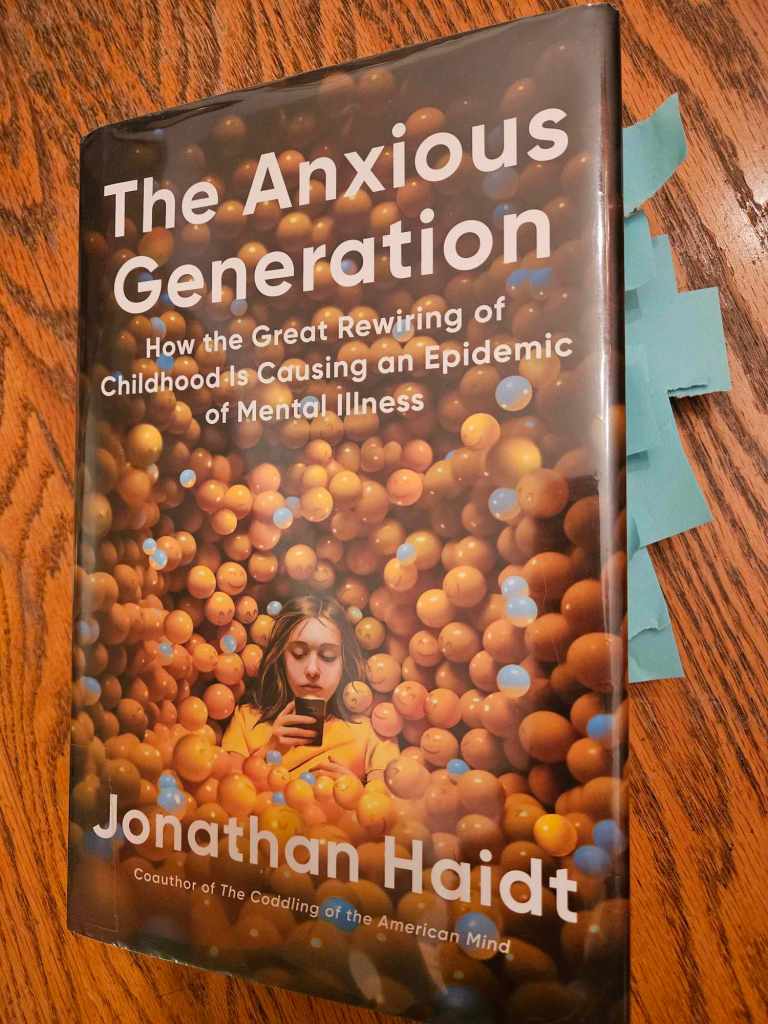
These two phrases—phone-free and play-full—are my big takeaways from Jonathan Haidt’s bestselling book The Anxious Generation: How the Great Rewiring of Childhood is Causing an Epidemic of Mental Illness. The copy I read is pictured above, with my many sticky notes still attached.
You might know Haidt as the co-author of the 2018 bestseller about college students, The Coddling of the American Mind: How Good Intentions and Bad Ideas Are Setting Up a Generation for Failure, among other books. He’s an NYU professor and social psychologist who says in The Anxious Generation what has been obvious to many people just from observation and personal experience, and he’s got the data to back it up.
This well-researched book begins with a discussion of the problem, in a chapter called “The Surge of Suffering.” He then discusses how play-based childhoods have, for Gen Z and Gen Alpha, become a thing of the past, overtaken by the phone-based childhood. Haidt identifies four foundational harms that come from phone-based childhoods, and then appropriately discusses girls and boys separately, since their lives and their brains are influenced by the internet in generally very different ways. Using numerous charts and graphs, he clearly demonstrates the wave of anxiety and mental illness that has been rapidly advancing since around 2010.
(While writing this review, I was curious about the first-ever iPhone and found the original press release, dated January 9, 2007. It’s both quaint and nostalgic … and ironic and darkly prescient—all in the same first paragraph.)
I have only two minor quibbles with Haidt’s section on the phone-based childhood: I wish that he had given more space to the shockingly rapid rise of gender dysphoria, especially among girls, and its correlation to social influence and sociogenic transmission (a term he defines in the girls’ chapter). Fortunately, that topic has been covered extensively in another excellent book: Irreversible Damage: The Transgender Craze Seducing Our Daughters, by Abigail Shrier. I also wish he had not hedged on the overall harmful effects of internet pornography on men of all ages, as well the scourge it is to women, marriages, families, and society in general. But in fairness, that’s probably outside the scope of this book.
Haidt ends his book with a plea for, and evidence to encourage, collective action from governments, tech companies, schools, and parents in order to restore phone-free, play-full childhoods and turn the epidemic of anxiety around. I’m not going to hold my breath waiting for government or tech companies to act, but recently, more schools seem to be considering banning smartphones from classroom time (ideally that would expand to include the entire school day). And parents can always choose to give their children smartphones at much later ages. Some families I know today have chosen this route—the beginning of high school, for example, or when they start driving—a very encouraging development that I hope will catch on.
Regarding the play-full aspect of childhood, some of my favorite parts of this book were the sections on “loose parts” or “junkyard” playgrounds, free play, recess, anti-fragility, and risk-taking in children’s play. Haidt gives many details on playgrounds of the past and present that are unlike the ubiquitous and totally “safe” playgrounds of the past twenty or thirty years. Play areas where kids have outdoor spaces to themselves, and where adults are encouraged to keep quiet and let their children play largely unsupervised, in order to grow emotionally and physically strong and gain confidence in their own problem-solving abilities.
The Anxious Generation is a must-read book for every parent and educator, but as Haidt says in his Introduction, it’s “not just for parents, teachers, and others who care for or about children. It is for anyone who wants to understand how the most rapid rewiring of human relationships and consciousness in human history has made it harder for all of us to think, focus, forget ourselves enough to care about others, and build close friendships. The Anxious Generation is a book about how to reclaim human life for human beings in all generations.”
So even if you have no immediate children or adolescents in your own life, the information in this book applies to all of us. I highly recommend it, and you can get it here.
(Haidt quotes from author and psychology professor Jean Twenge quite often in this book. If you love charts and graphs and learning about the differences between the generations living today, I also recommend reading Twenge’s Generations: The Real Differences Between Gen Z, Millennials, Gen X, Boomers, and Silents―and What They Mean for America’s Future—one of my favorite books of 2023.)
The links for qualifying purchases in this post earn me a small commission from Amazon, which I use to offset the costs of running this site.

 Great and Noble Tasks