
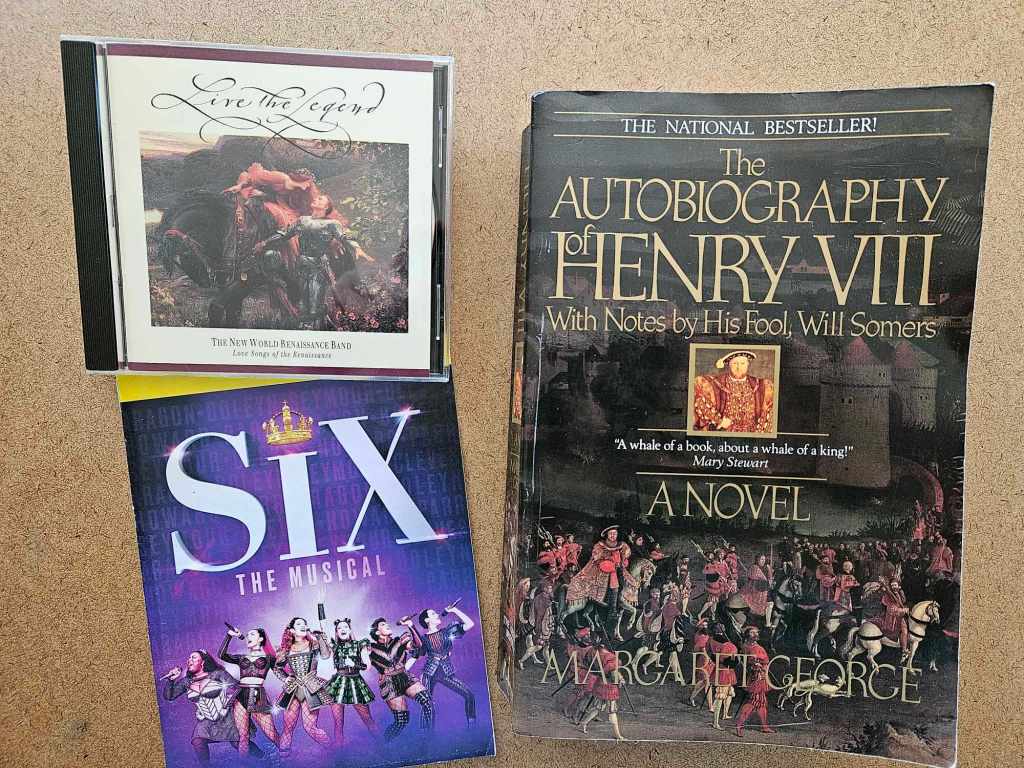
What comes to mind when you hear the name Henry VIII?
When author Margaret George asked people this question, here’s a summary of the answer she got: “Henry VIII was a huge, fat, oversexed man with gross table manners who had eight wives, killed them all, and then died of syphilis.” She found out during the course of extensive research that not one of these things about Henry was true, or at least, not entirely true.
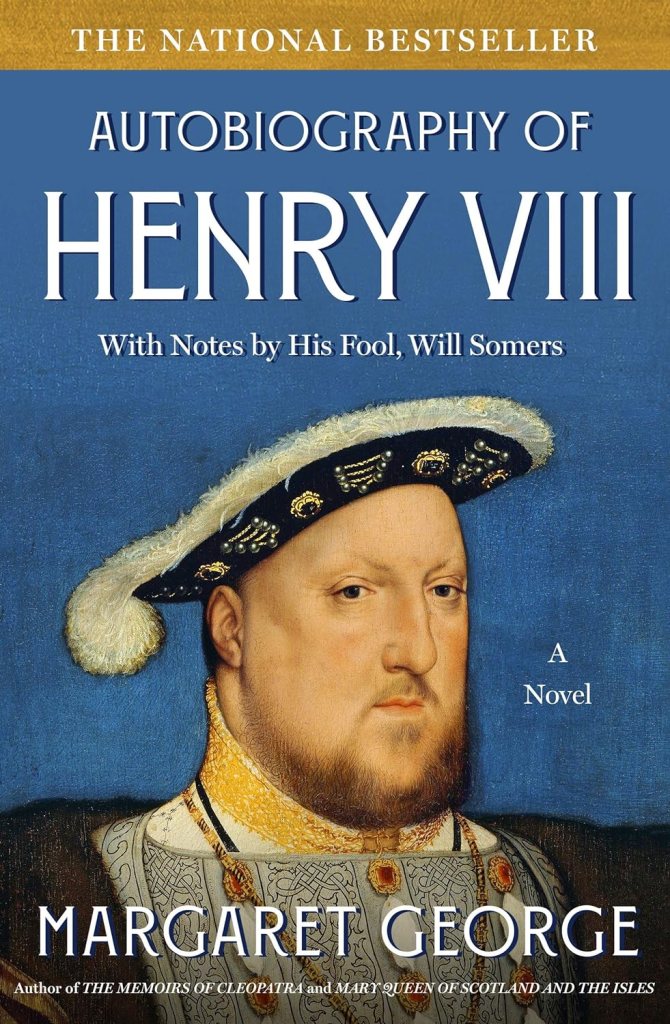
So she wrote a 900-page novel about him, making the daring decision to tell his story in first person: The Autobiography of Henry VIII. It’s fiction, but it’s based on solid research, and it provides a fascinating look at the entire character of this complex and important historical figure.
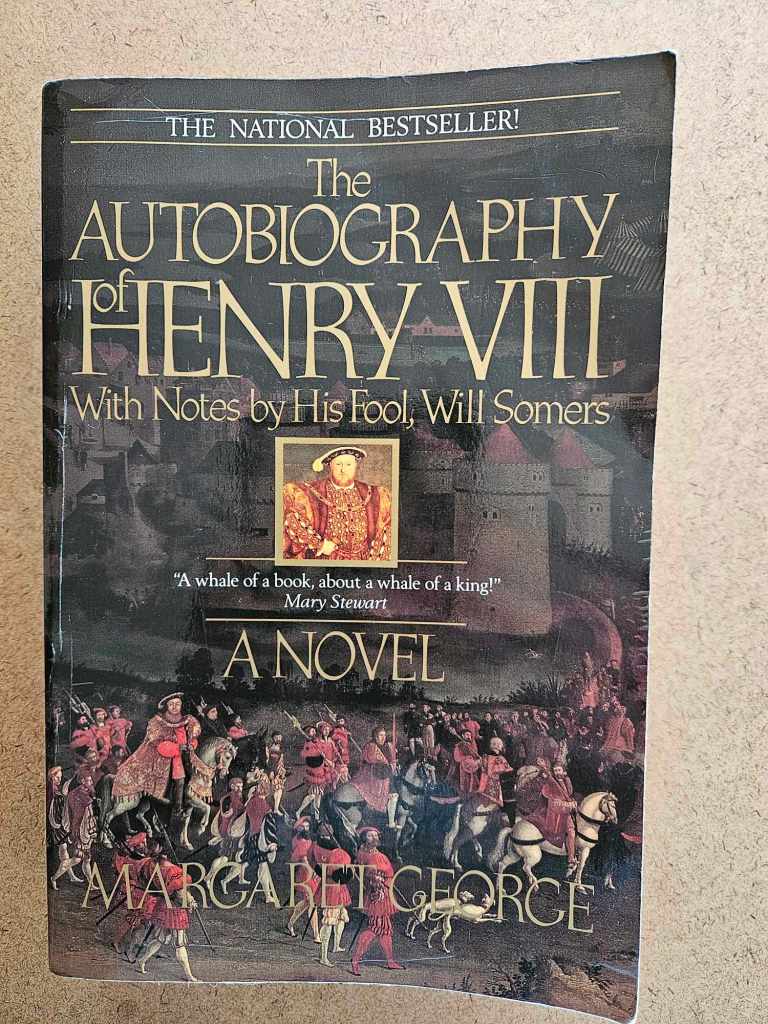
The Perspective: George writes the book in first person, as Henry. But the subtitle is “With Notes by His Fool, Will Somers.” His court jester is an intelligent, literate man who finds Henry’s journal after his death and adds his own notes to it throughout (there is a set-up at the beginning of the book that explains why he does this). These notes from an objective, reliable eyewitness are an effective way for George to give us someone else’s perspective besides Henry’s alone.
The Humor: There is humor throughout the book, some of it based on what we as modern readers already know of Henry, his story, and his ego. One particularly funny section is his anticipation before he meets Anne of Cleves, his as-yet-unseen fourth wife, whom he expected to be beautiful … and she was not. Henry’s charmingly naïve yet frankly sexist expectations, his mental gymnastics as he prepares for an “uneducated but sweet” German bride, his shock upon meeting her and hearing her speak—it not only made me laugh, but made me incredibly grateful, as a woman, that I was born in the twentieth century rather than the sixteenth. (Fittingly, Anne of Cleves turns out to be not only a very smart woman, but a very lucky one, as well.)
The Wives: “Am I not a man like others?” Henry bellows, after failing once more to produce a male heir. Will Somers, Henry’s fool, considers this question early in the novel. In retrospect, he sums up the fate of Henry’s manhood (as viewed by Henry and everyone else in the Western world at the time) with his six wives: “His first bride ultimately preferred her beads and confessor. His second mocked his potency and cuckolded him with his courtiers. His third soothed him, but soon died. His fourth was so distasteful to him he could not perform—but nonetheless it was humiliating to have to obtain a public annulment on the basis on nonconsummation. The fifth cuckolded him in grand style and held him up to public ridicule. The sixth—he was too ill to use her services for anything beyond nursing, and even she was reported to have said, in response to his proposal, ‘Sire, it were better to be your mistress than your wife!’” Each of these stories is covered in respective detail throughout the book.
The Rating: This book has very little language or violence (other than the obvious beheadings), but it’s definitely rated R for sexual content throughout. If this is something you try to avoid, then you probably need to say no to this one, due to the graphic nature of this content. I felt that George handled it in an authentic manner, since she was writing from Henry’s point of view; his preoccupation with his virility and his increasing insecurity about his manhood are important aspects of his character—and why he is remembered the way that he is.
The World Politics and Religion: I’ve read about the Tudors several times with my kids during homeschool, and this book brought back to mind so many of the details: how Henry was trying, with the Church of England, to create a sort of “middle ground” between Catholicism and the new Protestantism, both of which he hated; how many of his advisors he had executed and why; how many monasteries he destroyed, and upon what advice he did this; England’s battles with France and Scotland; the ongoing tension between Europe and the Turks; the constant presence of influential “Thomases” in his life: Cranmer, More, Cromwell, and others; and the incredible, worldwide importance of religion in general, both in everyday life and in all aspects of politics and the monarchy.
Just before I read this book, I asked myself the question at the beginning of this review: What do I think of when I hear the name Henry VIII?
One key memory I associate with that name takes me back to 1994, when my husband and I attended a live concert by Owain Phyfe and the New World Renaissance Band. One of the songs they played was “Pastime in Good Company,” written by Henry VIII—which surprised me. I wasn’t aware at the time that Henry was a gifted poet, musician, and composer. There’s no denying that he was a romantic at heart, and he wrote some beautiful music as a result. You can listen to “Pastime” here with traditional singers and Renaissance-era paintings, and you can listen here to Owain Phyfe as I heard him 30 years ago.
My second important memory is much more recent, when I saw the hit Broadway musical Six for the first time. “Six” refers to Henry’s six wives, who are the only characters in this show. If you are an historical purist and expect a musical in period costume with appropriate seriousness for the subject matter, then you absolutely do not want to see this show. But if you’re intrigued by something entirely different—namely, Henry’s six wives participating in a contemporary pop-star singing competition—then this is the show for you. The opening number, “Ex-Wives,” is here, and you’ll know if you’d like it or not based only on that, I promise. I loved it. (Fun fact: In the opening song, Anne Boleyn refers to her green sleeves, which is a reference to the longstanding belief that Henry VIII wrote the classic tune “Greensleeves” after seeing her in a green dress. Historians today agree that he didn’t write it, after all.)
But of course, both the Renaissance concert and the contemporary musical offer an incomplete view of Henry VIII. Henry, like all of us, was a complex, multi-faceted human being … albeit with the god-like power and standing of an absolute monarch. I really enjoyed how Margaret George’s novel offered a well-written, more complete picture of this important king. She also provides an annotated list of recommended books at the end of The Autobiography of Henry VIII, for further reading.
The links for qualifying purchases in this post earn me a small commission from Amazon, which I use to offset the costs of running this site.

 Great and Noble Tasks